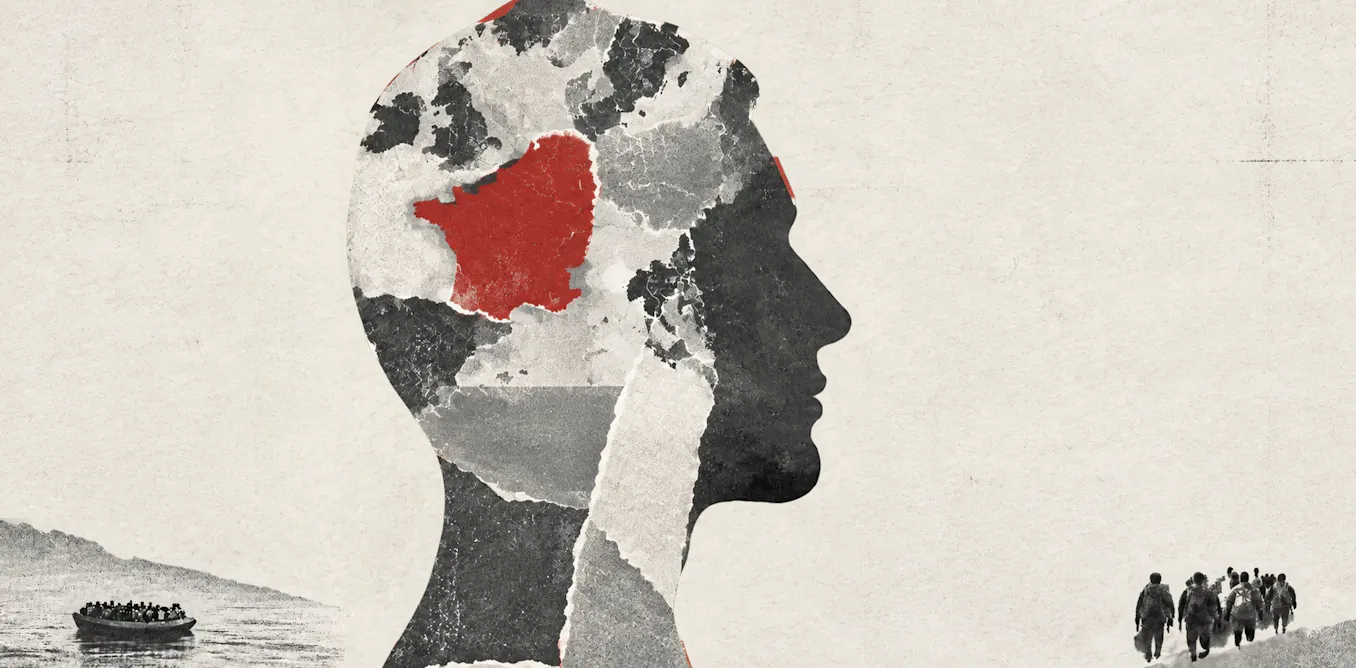
What makes someone French, German, British or Danish? Is it the passport they hold, the language they speak, or the ancestry they inherit?
Across Europe, parts of the nationalist right are increasingly blurring the distinction between culture and ethnicity. The result is a view of national identity where belonging depends on where a person’s ancestors come from.
This way of thinking is called ethnonationalism – where membership of a nation depends on ethnic background or ancestry, rather than simply on citizenship or cultural identity.
In Denmark, where I live, this idea has recently taken a striking turn. A few months ago, I appeared in a televised debate opposite a former political adviser to a Danish right-wing party who, in essence and quite seriously, argued that to be Danish, you have to be able to tolerate milk.
The argument draws on the fact that the ability to digest lactose, the sugar in milk, is more common among people with Northern European ancestry. The suggestion was that this biological trait could help define who is truly Danish.
Others on the nationalist right soon made similar arguments. One commentator wrote that Danish ancestry should be the basis for defining Danishness, because cultural “spirit” ultimately derives from blood.
But while the ability to digest milk might seem an absurd test of Danishness, the underlying question is a serious one and it extends far beyond Denmark.
When citizenship isn’t enough
Similar ideas are gaining ground elsewhere in Europe. In France, Marine Le Pen’s nationalist political project has promoted an ethnonationalist view of national identity, in which ancestry plays a central role in defining who belongs.
While Germany’s far-right Alternative for Germany (AfD) has also made ethnonationalist claims as it has gained ground. In 2025, Germany’s domestic intelligence agency classified the party as right-wing extremist, although the legal status and implications of that classification have been contested.
These movements differ, but they raise a common question: can someone be a citizen of a country, live there for years and participate in its society, yet still be considered an outsider because of their ancestry?
This distinction between legal citizenship and supposedly authentic national belonging is central to the nationalist right’s calls for “remigration” across Europe.
The term is used by proponents to argue that people with migrant backgrounds should be removed from countries where they live, even when they have citizenship or were born there. This can include calling for the mass deportation of people deemed not to belong to the nation because of their ethnicity, ancestry or cultural background.
Such ideas often overlap with the so-called “great replacement” conspiracy theory, which claims those with non-Western backgrounds are replacing existing populations. And elements of this narrative have been adopted by nationalist and far-right politicians across Europe.
Something has changed
The word “ethnocultural” brings together two ideas: that a nation has a distinctive culture and that this culture belongs to a particular ethnic group. It suggests that national identity is not simply something people can learn or participate in, but something rooted in their origins.
Some researchers describe the shift in how nationalist politicians talk about national identity as a “cultural turn”. Rather than focusing explicitly on race or ancestry, they increasingly talk about protecting a country’s culture, values and way of life.
On the surface, that might sound more inclusive; people can learn the language or adopt new customs. But if a country’s culture is treated as something you inherit from your ancestors, rather than something you can share and take part in, the boundary between insiders and outsiders remains.
European values?
My research in Denmark has examined how national identity has changed over time. The findings suggest that, despite what some nationalist political groups argue, most people do not see ancestry as the defining feature of national belonging.
The Danish Values Study, part of a wider European survey, asks people about their beliefs and values. Comparing responses from the most recent 2008 and 2017 surveys, the proportion who thought being Danish was mainly about having Danish roots fell from 19% to 15%.
Meanwhile, around four in five saw being Danish as a matter of belonging to the country and its society rather than having a particular ethnic background. This figure remained almost unchanged, at 77% in 2008 and 79% in 2017. These findings offer a different perspective from the idea that national identity is rooted in blood (or milk).
This understanding also has roots in history. The Danish theologian NFS Grundtvig expressed a vision of national belonging in his 1848 poem Folkeligheden: “To a people all belong, who count themselves as part of it”. In other words, belonging is something people can claim for themselves, rather than something dictated by family background.
That said, the poem has featured in debates about Danish identity, with figures on the right using it to argue for a narrower definition of national belonging, while others see it as an argument for a more inclusive idea of Danishness.
And ultimately this raises the broader question: who has the legitimacy to define who belongs to a country or not? A question that will likely be a defining feature of European politics for years to come.
This article was commissioned as part of a partnership between Videnskab.dk and The Conversation. Articles are also published in Danish.