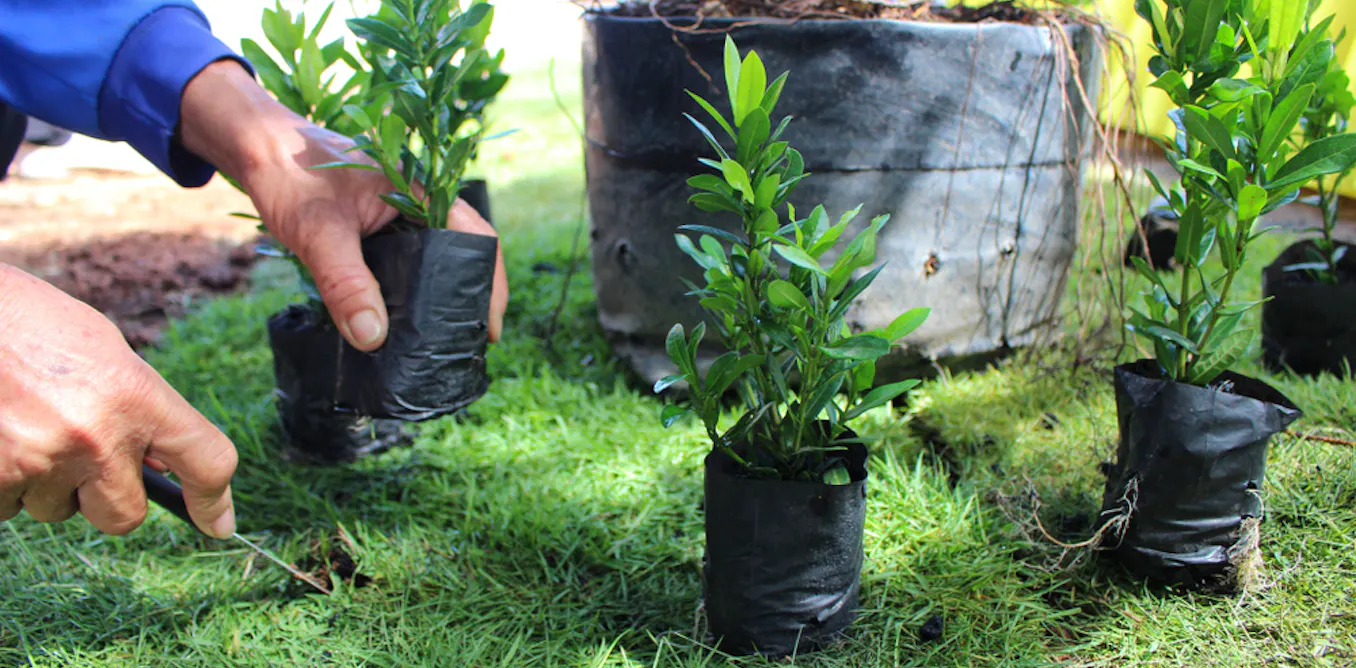
Climate change is bringing extreme summer heat to many more countries, but using the right plants in your garden could help keep your home that bit cooler next summer.
As the autumn planting season begins, this is a great time to plan ahead for next summer. Planting at this time of year can also help your climbers and shrubs get settled ahead of spring.
After the 2026 heatwaves, many people are looking at what they can do to help mediate those very hot days that have started to happen more regularly. But that doesn’t have to mean investing in an expensive air-conditioning unit.
Anyone with a garden, or even balcony, could have a far cheaper answer. Plants are nature’s own air-conditioning units.
Plants mitigate excess heat in three main ways. They create shade near them, reducing the amount of solar light that is absorbed and which bounces back from hard surfaces such as roads or driveways as infra-red radiation (heat).
They also use light to evapotranspire – converting liquid water into vapour – and this dissipates energy without raising the temperature. This keeps plant tissues and their surrounding environment cool. And thirdly, depending on their leaf properties (colour, texture, waxiness or hairiness), some plants also reflect incoming solar radiation back out to space (the albedo effect), avoiding this energy being converted into heat. Silver-leaved plants are thought to be particularly good for this, for instance, Colorado spruce, blue festuca grass or lamb’s ear.
Researchers have known for many years that plants can both cool a building in summer and insulate from cold in winter. But many of the systems advocated for commercial buildings – green “living” walls and green roofs are relatively expensive and difficult to construct for the average homeowner.
Yet plants provide the same services whether they are part of a sophisticated architectural feature, or simply garden specimens positioned to improve the aesthetics of the house or provide food for the household. Indeed, some of the most effective passive cooling systems for homes involve plants such as wall climbers (vines), wall shrubs or trees strategically placed to block the sun in summer.
So, whether it is roses, wisteria and clematis that enhance the old-English cottage garden ambience or cherries, apples or tomatoes that deliver fare for the dinner table – plants trained against a house provide a cooling effect directly to the walls, and indirectly to the interior of the house.
My research with colleagues has shown placing plants in front of a south-facing brick wall can reduce the surface temperatures by as much as 25°C. But it’s worth noting that some plant types are better at cooling than others. There is a hierarchy of coolness. Ivy and honeysuckle are consistent coolers, whereas winter jasmine and rockrose are less effective across a range of weather conditions. It is also evident that all plants cool via shade and evapotranspiration, but some do a better job than others.
This has practical implications – with plants that are shade coolers the aim is to maximise the amount of foliage between the sun and the wall. These are plants with naturally large, dense canopies such as cherry laurel and evergreen viburnums, whereas almost the opposite is true for transpirational coolers, such as hydrangea, fuchsia and clematis. These have a thin veil of leaves which optimises cooling performance. The latter, of course, are dependent on a reliable source of water, so perhaps not the subjects to choose if your area has regular hosepipe bans.
In practice, a mix of wall shrubs and climbers grown against a south-facing wall, not only provides visual aesthetics, but a diverse range of cooling strategies and mechanisms. The heat insulation process is enhanced by leaving an air gap between the plant and the wall, so planting the shrub 0.5 metres away from the wall or having a wooden trellis to grow the climbers up, but free from the wall, is ideal for this.
Read more: Only 3% of UK homes have air conditioning. What are the costs and consequences of fitting it?
It is not just the house that benefits. Careful design with shading and evapotranspiring plants can provide a more comfortable patio or children’s play area, and we are currently investigating the potential of movable pot plants to provide localised cooling in front of glassed areas, such as French windows, conservatories or on south-facing balconies.
Creating a green façade for your southern aspect walls is far less expensive than putting in air conditioning, and better for the environment as it doesn’t produce emissions or heat up the air.
Climbing annuals (nasturtium, morning glory, sweet peas, thunbergia), tall, flowering annuals (sunflower, larkspur, cosmos), biennials (foxglove) or short-lived perennials (hollyhock, rudbeckia, mullein, delphinium) work equally well as perennial shrubs and climbers and can all be grown from seed (£2-3 per pack).
For those with a bit more cash to spare (£10-£20 per plant), perennial climbers also be great value as they can last for 15-20 years. These include roses, passionflowers, clematis, solanum, wisteria, ivy, summer flowering jasmine, perennial peas and honeysuckle.
A bonus is these plants look wonderful, and in some cases have fantastic scent, and are not noisy. Who ever said that of an air conditioning unit?