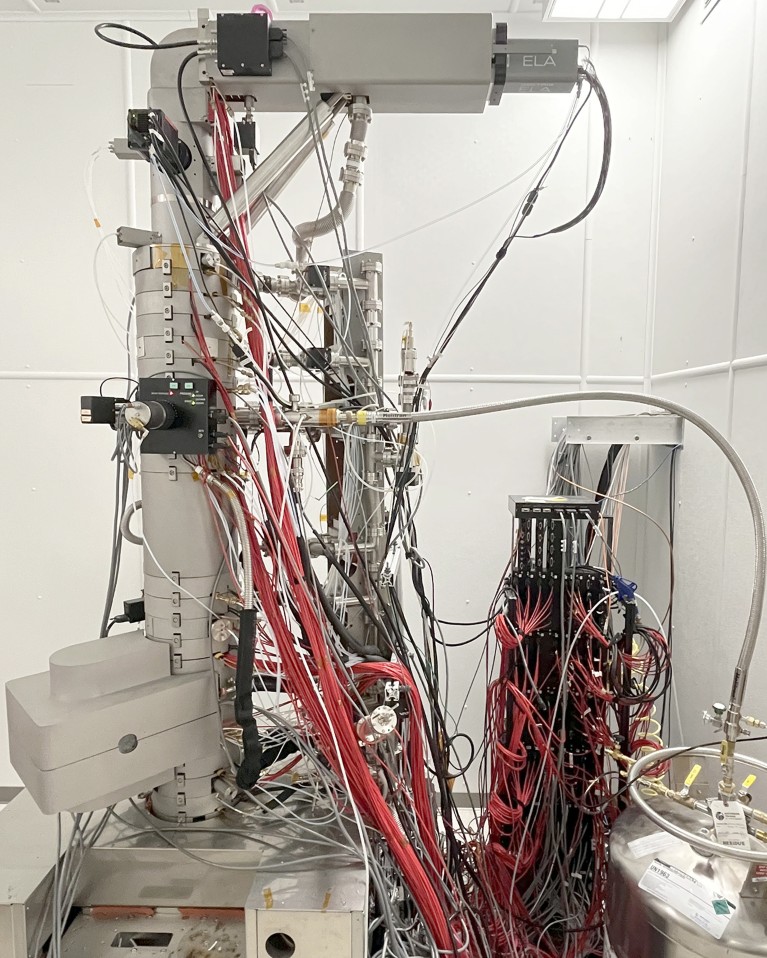
When it comes to imaging materials, the colder the sample is, the better. At room temperature, atoms hum with thermal energy and appear blurry in images, but at ultra-cold temperatures, near absolute zero (0 kelvin), they come almost to a standstill and can even adopt strange quantum behaviours. So, scientists have been on a decades-long quest to adapt some of their most powerful imaging instruments — transmission electron microscopes (TEMs) — to work at the coldest temperatures possible.
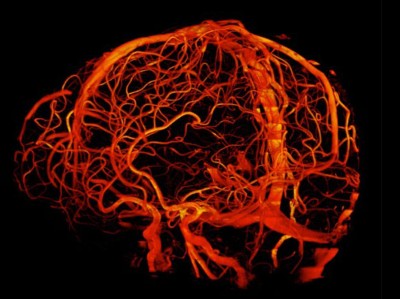
The world’s strongest MRI machines are pushing human imaging to new limits
Now, their dreams are finally becoming reality. Last year, researchers in the United States reported1 using an attachment for TEMs that cools samples to as low as −253 °C (20 kelvin) with liquid helium, enabling stable imaging of samples at atomic resolution for more than ten hours.
And by early next year, instrument maker Bruker, based in Billerica, Massachusetts, will ship the first-ever scanning transmission electron microscope (STEM) that stably operates near absolute zero using liquid helium to three laboratories in Canada, Germany and the United States. The device — dubbed GAIA, for Generational Advance in Instrumentation for Analysis — can image materials at temperatures as low as about −266 °C (7 kelvin) for 30 hours or more.
“It’s a little bit non-humble to name your microscopes after gods, but we’re pretty confident” in its abilities, says Tracy Lovejoy, vice-president and general manager at a division of Bruker. (In ancient Greece, Gaia was the goddess of Earth.)

Making samples one billion times bigger lets simple microscopes pinpoint amino acids
“It’s ridiculously exciting,” says Shelly Conroy, an electron microscopist at Imperial College London. Conroy has secured a time slot to use the GAIA microscope that will be delivered to the Ernst Ruska-Centre for Microscopy and Spectroscopy with Electrons in Jülich, Germany. The two other instruments will go to Oak Ridge National Laboratory in Tennessee and the Canadian Centre for Electron Microscopy in Hamilton.
Last year, electron microscopist Noah Schnitzer watched a demonstration of GAIA at the annual Microscopy and Microanalysis conference in Salt Lake City, Utah. He had previously used microscope attachments to image ultra-cold materials, a process that he says requires “a huge amount of optimization”, and “fighting the system all along the way”.
GAIA’s stability is impressive, says Schnitzer, who works with Conroy at Imperial College London. “That’s kind of the whole game” in microscopy, he says.
The road to resolution
Marrying TEMs and STEMs with cryogenic systems that allow the instruments to work at ultra-low temperatures is not a new idea. Scientists have long used temperature as a “tuning knob” to nearly freeze atoms in place and trigger the emergence of certain properties in materials, says Suk Hyun Sung, an electron microscopist at the University of Michigan in Ann Arbor, who helped to develop the TEM attachment reported last year.
Most often, electron microscopes are cooled with liquid nitrogen, which lowers samples to around −196 °C (77 kelvin). To get colder than that, scientists knew they’d need to work with liquid helium, which condenses at around −269 °C (4 kelvin). The problem was that liquid helium is tricky to work with.
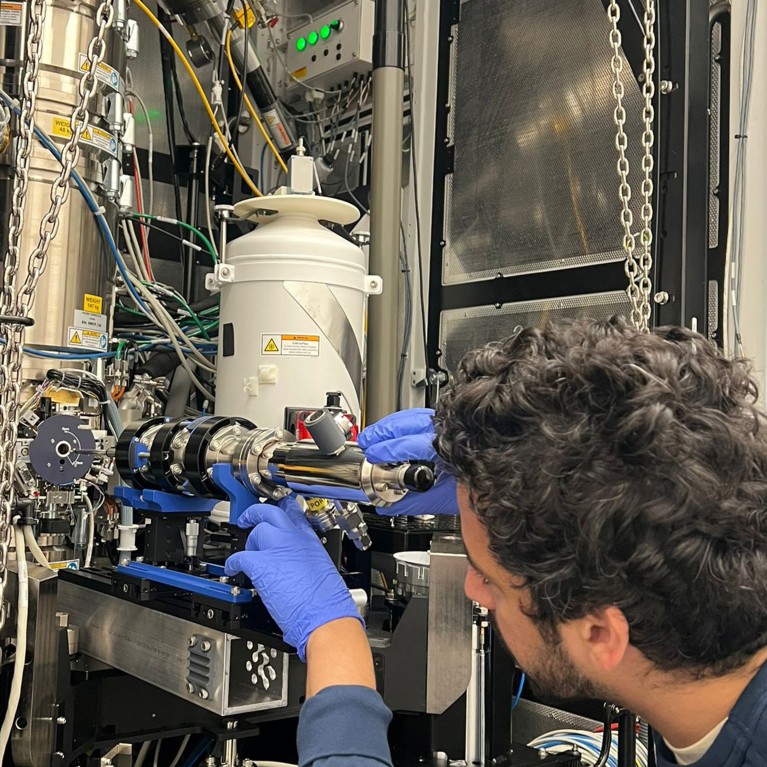
In TEMs, samples are held with a rod attached to a thermos-like container called a dewar, which would hold the liquid helium. But the liquid helium evaporates so rapidly that it would vibrate samples, blurring images. Data were near impossible to reliably collect and could usually only be done briefly under these conditions. One company, Zurich-based condenZero, developed a liquid-helium-cooled attachment that plunged materials to around −269 °C (4 kelvin) for 24 hours, but did not aim for atomic resolution.
In 2020, Robert Hovden, an electron microscopist at the University of Michigan, and his colleagues set out to create one that would. They used a heat exchanger and some other engineering tweaks to reduce vibrations from the liquid helium and obtain clearer images. In 2022, Hovden co-founded h-Bar Instruments in Ann Arbor to commercialize the attachment.
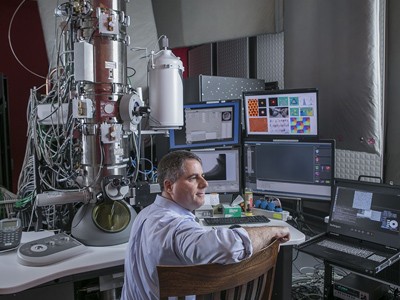
The microscope revolution that’s sweeping through materials science
GAIA also uses liquid helium, but incorporates it directly into the microscope. Its development began in 2017 at the electron microscopy company Nion, which Bruker acquired in 2024. In addition to offering super-cold imaging at atomic resolution, it has some other features that researchers are excited about. GAIA is ‘aberration corrected’, as are some other electron microscopes, meaning that it’s equipped with lenses and software that fix natural blurring or distortion that occurs during imaging, to yield crisper ‘snapshots’ of samples. It also has a monochromator that controls the energies of the electrons that strike samples, enabling researchers to study how materials respond to low-energy excitation.
Enjoying our latest content?
Log in or create an account to continue
- Access the most recent journalism from Nature's award-winning team
- Explore the latest features & opinion covering groundbreaking research