Long before I knew Finnish-Swedish author and artist Tove Jansson as the creator of the Moomins, I knew her as a name in the margins of The Annotated Hobbit.
Edited by Tolkien scholar Douglas A. Anderson, the book contains explanations of the numerous literary allusions and references to the wider Middle-earth legendarium which dot the landscape of J.R.R. Tolkien’s first novel. It also features more than 150 illustrations from global editions of Tolkien’s beloved classic, including several of Jansson’s for the Swedish translation – (A Hobbit’s Adventure, 1962).
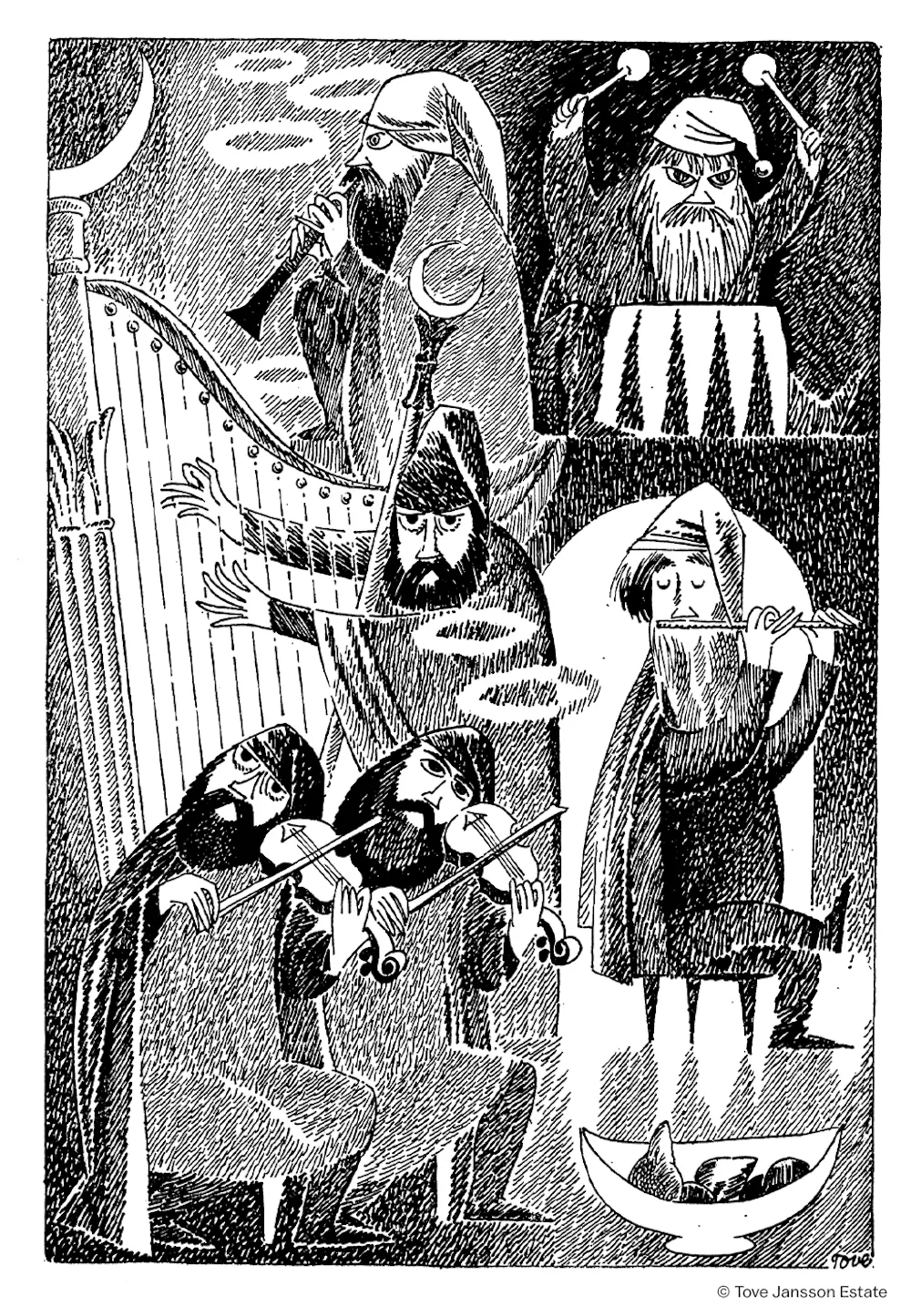
The recent release of The Hobbit: Illustrated by Tove Jansson marks the first time that a full edition of her Tolkien illustrations has appeared in English. And perhaps now the general reader may understand why my child self was so intrigued by them.
The creator of the Moomins and the maker of Middle-earth may not seem like an obvious pairing, but there are certain parallels between them. Jansson was a Swedish-speaking Finn. Finland’s national epic, The Kalevala (1835), exercised an enormous influence on Tolkien’s legendarium.
Both Tolkien and Jansson’s respective imaginations were fundamentally shaped by Finnish myth and folklore. Moreover, Tolkien heavily borrowed from what he called the “linguistic aesthetics” of Finnish for his invented Elvish language Quenya.
Even bearing this in mind, Jansson’s black-and-white illustrations are very clearly a product of a world before Peter Jackson’s Lord of the Rings trilogy (2001-2003) set the benchmark for visual adaptations of Tolkien’s work.
In 1962, fantasy had not yet solidified as a distinct publishing genre. It would take the transformation of The Lord of the Rings into a full-blown cultural phenomenon in the late 1960s to do that. This gave artists greater license to interpret The Hobbit as a standalone work of children’s literature, rather than as a prequel to an epic masterpiece.
Jansson did not take The Hobbit’s intended audience as an excuse to “soften” her visualisation of Middle-earth, however. In a 1961 essay, she opined that there is an “intense horror sensation […] in every honest children’s book”. As scholar of children’s literature Olga Holownia has explained: “An opportunity to create horror-infused landscapes was Jansson’s key motivation behind taking on the Tolkien commission. She found the scenery ‘seductive in its macabre ferocity’.”

Jansson’s work on The Hobbit bears this out. Filled with dynamic movement and a sense of the sublime, it showcases a different side of her visual personality, even as its bears her unmistakable artistic imprint.
There is more than a hint of Snufkin (the free-spirited wanderer of her Moomin stories) about her Bilbo in his travelling cloak and out-sized hat. But the Misty Mountains are as far from Moominvalley as it’s possible to get, and the ruined gates of the Lonely Mountain resemble the monstrous jaws of Smaug the dragon himself, with plumes of billowing steam and dragon-fire.

Here and elsewhere, the characters are literally dwarfed by the landscapes they move through and the creatures they meet there. Consider Jansson’s Gollum. Far from a gnarled, shrunken hobbit, he towers over Bilbo like a slimy cave-troll. Those looking for illustrations that precisely match Tolkien’s words will find themselves disappointed. But I would argue that Jansson captured the “ecstatic truth” of being a small person in a vast and imposing world – that is to say, of being a child.

There is no surviving record of Tolkien’s opinion of Jansson’s work. What we do know is that he was iffy on the idea of fantasy illustration at all. In his seminal essay On Fairy-Stories (1947), he wrote:
If a story says ‘he climbed a hill and saw a river in the valley below,’ the illustrator may catch, or nearly catch, his own vision of such a scene; but every hearer of the words will have his own picture, and it will be made out of all the hills and rivers and dales he has ever seen, but especially out of The Hill, The River, The Valley which were for him the first embodiment of the word.
Tolkien’s stated beliefs about visual art and fantasy hardly stopped him from illustrating his own work. Indeed, since The Hobbit’s publication in 1937, Tolkien’s pictures have become all but canonical.
Anyone who has ever watched Hayao Miyazaki’s Spirited Away (2001) or Guillermo del Toro’s Pan’s Labyrinth (2006) – or, for that matter, Jackson’s Lord of the Rings – will know that visual media possess unique enchantments of their own. So, too, does the work of Tove Jansson.