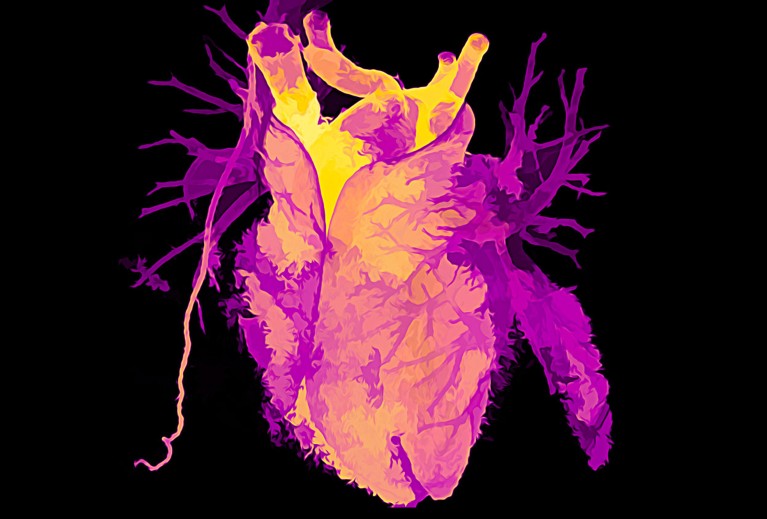
What happens to organs when they are transplanted? Hearts from young donors age rapidly in the bodies of older recipients, and older hearts are rejuvenated inside young people, according to a study1. The findings, posted on the preprint server bioRxiv and not yet peer reviewed, imply that replacement organs could be sourced from older people than they are at present.
Heart transplants are being performed more and more frequently around the world, and in ever older people, partly because people are living longer. In the United States, for example, there were a total of 4,636 heart transplants in 2024 — 81.5% more than in 2013. Still, hundreds of people around the world die each year while on waiting lists for new organs.
This has led to efforts to transplant organs grown in pigs into people, and, in many places, guidelines have been altered to expand the number of human hearts available for transplant. Generally, donors younger than 45 years old are recommended, although older ones who don’t show signs of significant coronary artery disease are also considered.
Now, Jesse Poganik, who studies ageing at Harvard University in Boston, Massachusetts, and his colleagues have investigated how donor hearts change their biological age — the amount of cellular damage they have accumulated — after transplant, in mice and in people.
Young at heart
The team grafted extra hearts from young mice (three months old), middle-aged mice (1 year old) and old mice (1.5–1.67 years old) into mice in all three age groups so that they lived with both the graft and the native heart.
Four to six months after the operation, they killed the mice and took tissue samples from them to measure their levels of DNA methylation — the addition or removal of chemical tags called methyl groups — in about 320,000 genetic regions, looking for changes that are linked to the cellular damage of ageing. They compared the ageing-linked methylation levels in the grafted hearts with levels in the animals’ original hearts.
The analysis revealed that the biological ages of donated hearts had changed to more closely match those of the recipients: younger hearts grafted into older animals showing accelerated ageing, and old hearts were refreshed in younger recipients.
This aligns with previous work in which two living organisms were surgically joined so that they shared a single circulatory system, a process known as parabiosis. The blood of young mice was found to extend the lives of older ones to which they were connected2, and to improve their memory and learning. The blood of older mice can increase biological age in young mice3.
Host’s rules
Next, Poganik and his colleagues looked into historical heart transplants at Brigham and Women’s Hospital in Boston, seeking those for which they could access biopsy samples to run DNA-methylation tests. They investigated 11 transplants with a substantial age gap between donor and recipient (8 to 24 years for older hearts grafted into younger people, and 38 to 50 years for younger hearts into older people).
“The remarkable thing is that we found exactly the same effects that we saw in the mice,” says Poganik. The transplanted hearts had taken on the biological ages of their new hosts.
The researchers also looked at the electronic medical records of hundreds of heart-transplant recipients one year after the operation, to investigate how well the hearts worked and how that was correlated with biological age.
They found that measures such as heart rate, the thickness of the heart’s posterior wall and exercise capacity were associated with the recipient’s age rather than the age of the donor. “Some, but not all, functional measures tracked the prediction that these older hearts in younger individuals functioned as if they were biologically younger, and vice versa,” says Poganik. “Some things are probably simply irreversible.”
Enjoying our latest content?
Log in or create an account to continue
- Access the most recent journalism from Nature's award-winning team
- Explore the latest features & opinion covering groundbreaking research