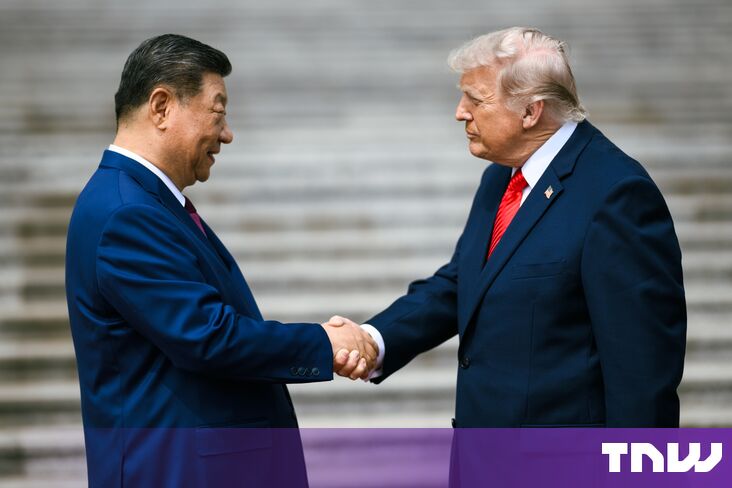
Sam Altman, Jensen Huang and Tim Cook are expected at the state dinner Donald Trump is hosting for Xi Jinping on 24 September. The same executives were on the Beijing trip in May, where AI safety was discussed, nothing was signed and the US trade representative said chip export controls never came up. Five months on, Chinese customs is still blocking the H200s Washington licensed, and Beijing has called the industry’s own slowdown proposal fearmongering.
Xi Jinping arrives in Washington next week and the technology industry is going with him. Ashley Gold reported for Semafor that OpenAI’s Sam Altman will attend the state dinner Donald Trump is hosting on 24 September.
Nvidia’s Jensen Huang and Apple’s Tim Cook are also expected, according to Reuters and Bloomberg. There are separate discussions about a White House meeting with AI chief executives, which House Speaker Mike Johnson has referred to and his office declined to detail.
This has happened already
Trump and Xi met in Beijing in May, with Huang joining the delegation late and Cook also on the trip. AI safety was on the agenda then too.
What emerged was a discussion of collaboration on shared safety standards and no agreement. The US trade representative said afterwards that chip export controls were not discussed at all.
Five months later the same men are in a different dining room. It is reasonable to ask what the first meeting produced before assuming much of the second.
The chips are the answer to that question
Washington cleared roughly ten Chinese companies to buy Nvidia’s H200, including Alibaba, Tencent, ByteDance and JD.com, with each approved buyer permitted up to 75,000 units. TNW reported that not a single chip had shipped.
By July a US trade official put it at very few, covering China and Hong Kong together. Chinese customs has blocked shipments, and suppliers of H200 components paused production as a result.
The deadlock is mutual and deliberate. American licences carry security and diversion conditions Beijing will not accept, and Beijing is steering its buyers towards Huawei and domestic alternatives regardless.
Which makes the guest list worth reading
Huang runs the company whose China accelerator share has gone from almost everything to almost nothing. He has said he supports export controls while being accused in the Senate of lobbying to loosen them, and both things can be true of a chief executive with a market he cannot sell into.
Cook runs the company with the deepest manufacturing exposure in China of any American firm. Altman runs the one whose models are banned there.
These are the three executives with the most at stake in market access. Safety is what hangs over the visit, and access is what the attendees are there about.
The safety agenda arrives pre-rejected
Dario Amodei published his case for slowing frontier development on 12 September, and TNW covered the proposal. Its third step was eventual coordination with authoritarian governments, China included.
Two days later a Chinese foreign ministry spokesman, Guo Jiakun, called it fearmongering, saying confrontation and vicious competition disrupt global AI governance. The state press described the essay as a veiled call to contain China.
Washington is not offering guardrails either
Trump has cited the need to stay ahead of China as the reason to avoid domestic AI rules. That is the same argument in the opposite direction, and it leaves both governments treating restraint as a disadvantage.
Beijing has answered the slowdown proposal by calling it a Cold War script. Neither capital has adopted the premise that a joint brake is desirable.
The mutual suspicion now runs into the products themselves. The two countries have begun formally warning against each other’s AI models.
The one thread that is live
Treasury Secretary Scott Bessent has signalled openness to discussing shared risks around AI with Chinese Vice Premier He Lifeng, in talks in New York laying groundwork for the summit. That is a narrower thing than coordinated pacing.
Shared risks is the language of bioweapons screening and model misuse, which is where Amodei himself said limited agreement might be possible. It is also the only part of the agenda that does not require either side to give up an advantage.
What a deal would look like
Chips remain the currency. Washington has already used Nvidia allocations as a term in a peace agreement, so the idea of trading compute access for something else is established practice.
The obvious trade is access for assurances. Chinese buyers take delivery, in exchange for verification arrangements Beijing has so far refused as intrusive.
Nothing in the last five months suggests either side wants that trade at the price currently on offer. The dinner may be the moment it changes, and the record says to wait for the text.
What to watch
Watch whether any chips actually move afterwards. A communique about safety costs nothing, and a customs clearance is evidence.
Watch whether the separate CEO meeting happens and who is in it. A room with Huang and Cook in it is about supply chains, and a room with safety researchers in it would be a different signal entirely.