Hello, and welcome to TechScape. I'm your host, Blake Montgomery, writing to you as I sit under yellowing leaves in New York. Today in tech, we're discussing technocracy.
Trump entwines his power with AI
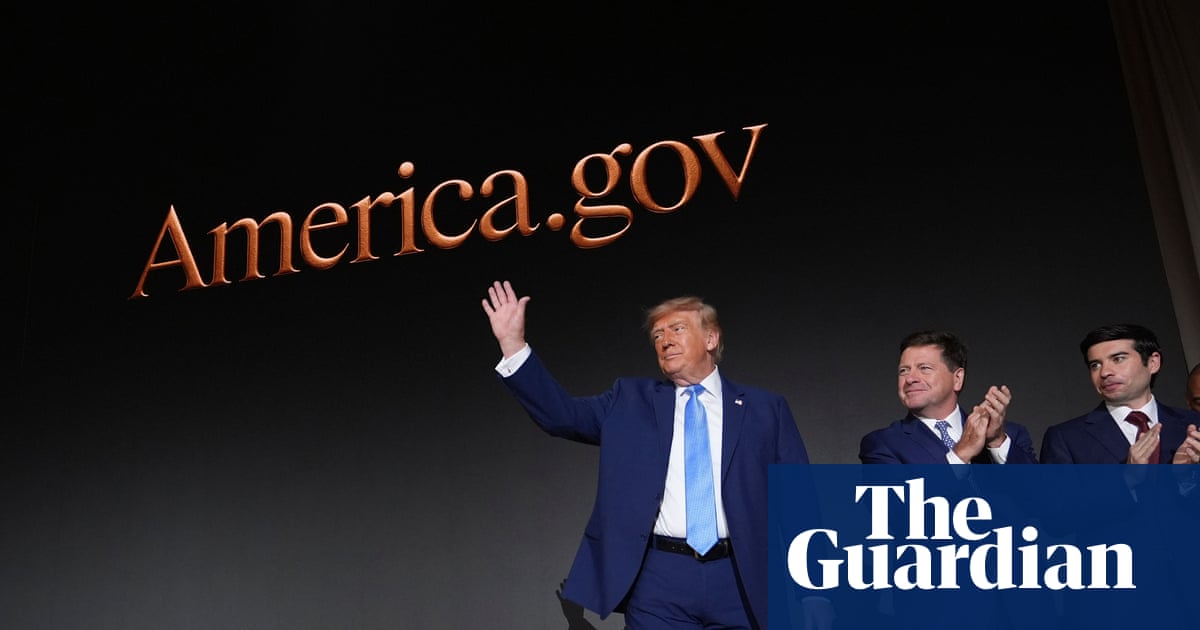
Donald Trump made a series of moves over the past week that make it clear his power is becoming synonymous with artificial intelligence.
The new tight alliances between the White House, the Pentagon, US intelligence agencies and AI companies loom ominously over governments and companies, particularly in Europe, that rely on American AI.
Last Tuesday, Trump and six AI CEOs signed what he called a "morally binding" agreement to put controls on artificial intelligence. The vague agreement stipulates a framework for what Trump called "tremendous self-policing", reiterating his point that AI companies can act as their own watchmen. Elon Musk, Mark Zuckerberg, Jensen Huang and Dario Amodei signed.
Zuckerberg hand-guided the writing of that agreement, Semafor reported. The pact reportedly arose from a conversation between the Meta CEO and House speaker, Mike Johnson, at the US state dinner for Xi Jinping, which preceded the conclave of the tech CEOs. Zuckerberg circulated a draft of the agreement in advance of the convening, and Huang threw his support behind it, per Semafor.
It is one thing for tech executives to dine at the White House to curry favor with the president; it is entirely another to have them draft the terms of executive orders. Silicon Valley's CEOs are writing contracts that bear the White House letterhead, entrenching their interests and their power.
"It's almost like a constitution in a way, and the biggest people in the world signed that, and I signed it as president, and it really is a form of protection," Trump said. Famously, constitutions are legally binding, which Zuckerberg and Trump's agreement is not.
The president also decreed that government documents render any reference to "artificial intelligence" as "super intelligence". How loyal will they be to his rebrand?
At least one acquiesced immediately: Musk copied the renaming by changing the name of one of his company's subsidiaries from SpaceXAI to SpaceXSI. The change coincided with the multi-CEO's re-entry into government work more than a year after his explosive term at Doge ended. On Thursday, the defense secretary, Pete Hegseth, named Musk to a taskforce to study the future of warfare alongside Palmer Luckey and Emil Michael, dubbed Project Meridian. The trio of men will release a report in 120 days with public recommendations on how to achieve "absolute technological dominance on the next-generation battlefield", in the words of Hegseth.
Over the weekend, the president announced that he had appointed Jay Clayton, director of national intelligence, as the AI czar of his administration.
Trump's first AI czar was a Silicon Valley insider. David Sacks is a venture capitalist who championed growth and deregulation during his term as a special government employee. He maintained direct financial stakes in multiple AI companies while working with the White House, indicating his ultimate goal was to build a bigger fortune. (He's made a name for himself recently championing AI accelerationism, the opposing philosophical camp to the "doomerism" of the Anthropic employees who prophesy extinction.)
Read more: 'An out-of-touch Silicon Valley radical': meet Trump's AI whisperer pushing for limited regulation
The second czar, Clayton, is the leader of the US's spy agencies, a job he will continue to hold in addition to overseeing AI initiatives. His joint appointment sends a very different message, one echoed by Hegseth: AI will supercharge the offensive capabilities of the US government, in particular surveillance and the gathering of intel. Clayton's ascendancy has major worldwide implications: US spying agencies dictating global AI policy does not bode well for the sovereignty of other nations that need cutting-edge AI.
The US economy is already extremely dependent on the growth of the artificial intelligence sector. The companies whose leaders attended Trump's summit are responsible for the majority of the US stock market's growth over the past five years.
The latest moves by Trump's administration signal that American power is likewise inextricable from AI, synonymous: executive authority, military might and the government's information. The White House pledge binds Trump and the AI CEOs together; Hegseth's taskforce ties the Pentagon to Musk and Luckey's visions of automated war in space; and making Clayton the AI czar predicts an era of AI-enabled spying, of government knowledge being gathered and filtered through large language models.
One point of striking divergence: labor. The economy writ large may rest on AI, but the workers of the US do not. The majority of the hiring happening in the US is not a result of AI companies' growth, according to the US jobs report released on Friday. Far more people are being hired to work in healthcare, a sector that still needs human labor more than automated work. AI may fuel gross domestic product growth, but it is not driving job creation on a national scale.