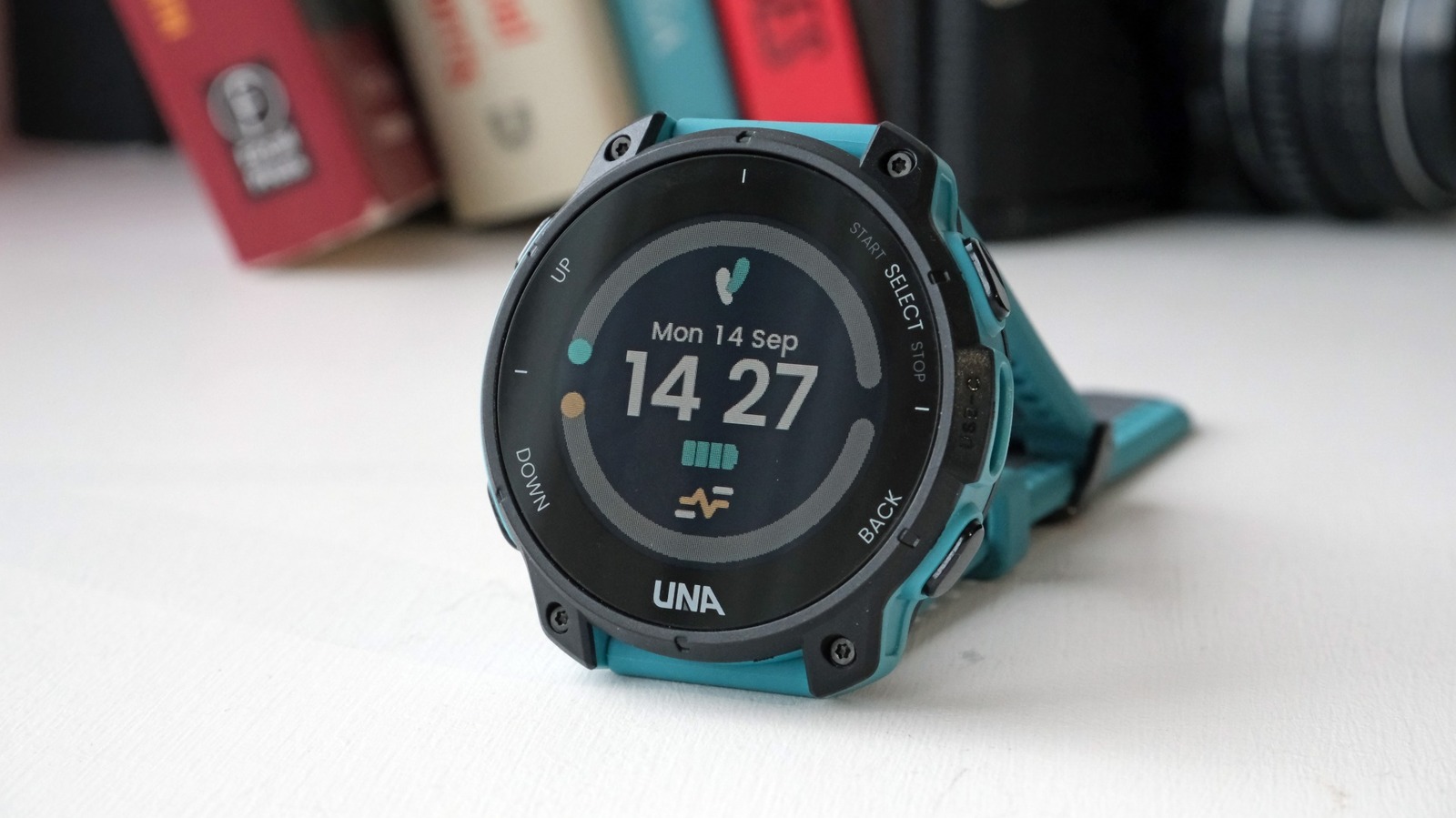
A phone-connected GPS watch is not a smartwatch, and so expectations need to be lowered to the appropriate level. There's almost no customization, the only thing you can change about the watchface is if you want your time displayed in 12 or 24 hours. There are three discrete menus, each one triggered with a different shoulder button — main menu, detailed activity data and the list of workouts you can track.
The list of trackable workouts is limited to walks, runs, hikes, bike rides, treadmill running or just a generic workout. But users are already filling in the gaps with their own tracking apps which are shared with others via the mobile app. I wouldn't expect a watch like this to have automatic tracking, especially given the target market of hardcore fitness nerds. But as a forgetful non-hardcore non-fitness nerd, I'm still allowed to miss it.
On the watchface, there are two semicircles. The upper one fills with blue the closer to get to your (self-defined) step goal. The bottom one fills with yellow the more time you spend being active, up to a target of 30 minutes per day. It's a neat implementation, although the muted colors on this low power display mean it's not as glanceable as you might wish.
The dual-frequency GPS seemed to do pretty well, finding my position in less than half a minute without much fuss. I also found, even though my walks and "runs" are rarely longer than half an hour, that repeated use didn't make much of a dent in the battery.
As for the companion app, it's very much the platonic ideal of a basic wearable app, especially given the limited functionality. On the homepage, you can see a dashboard breaking down your daily activity to that point, and the records of your last workout. Go into the activity tab and you'll be able to see all of your recorded workouts, and you can look at each one as a discrete thing. A stats pane will let you track your activity metrics in aggregate, but there's no greater insights available.
There's also a tab marked Store, where the community has started to make apps to expand the Una watch's functionality. So far, the list is small, but there are already dedicated apps to track the sunrise/sunset, trail running, high/low tide and squash games. And it wouldn't be a low power device with an open software development platform if it didn't also have . The game runs, but I'd advise against it unless you really love the idea of controlling an FPS with four watch buttons.
The Una watch is freshly-minted, and it's clear that there are a few usability issues the company needs to address. For instance, if you activate smartphone notifications, you'll get them displayed in beautifully clear text on the display. But it has no way of respecting your phone's Do Not Disturb settings, vibrating as it pushes everything to your wrist, no matter the time of day. And the only way to stop it is to turn them off entirely, making it a daily chore to turn them on and then back off again.