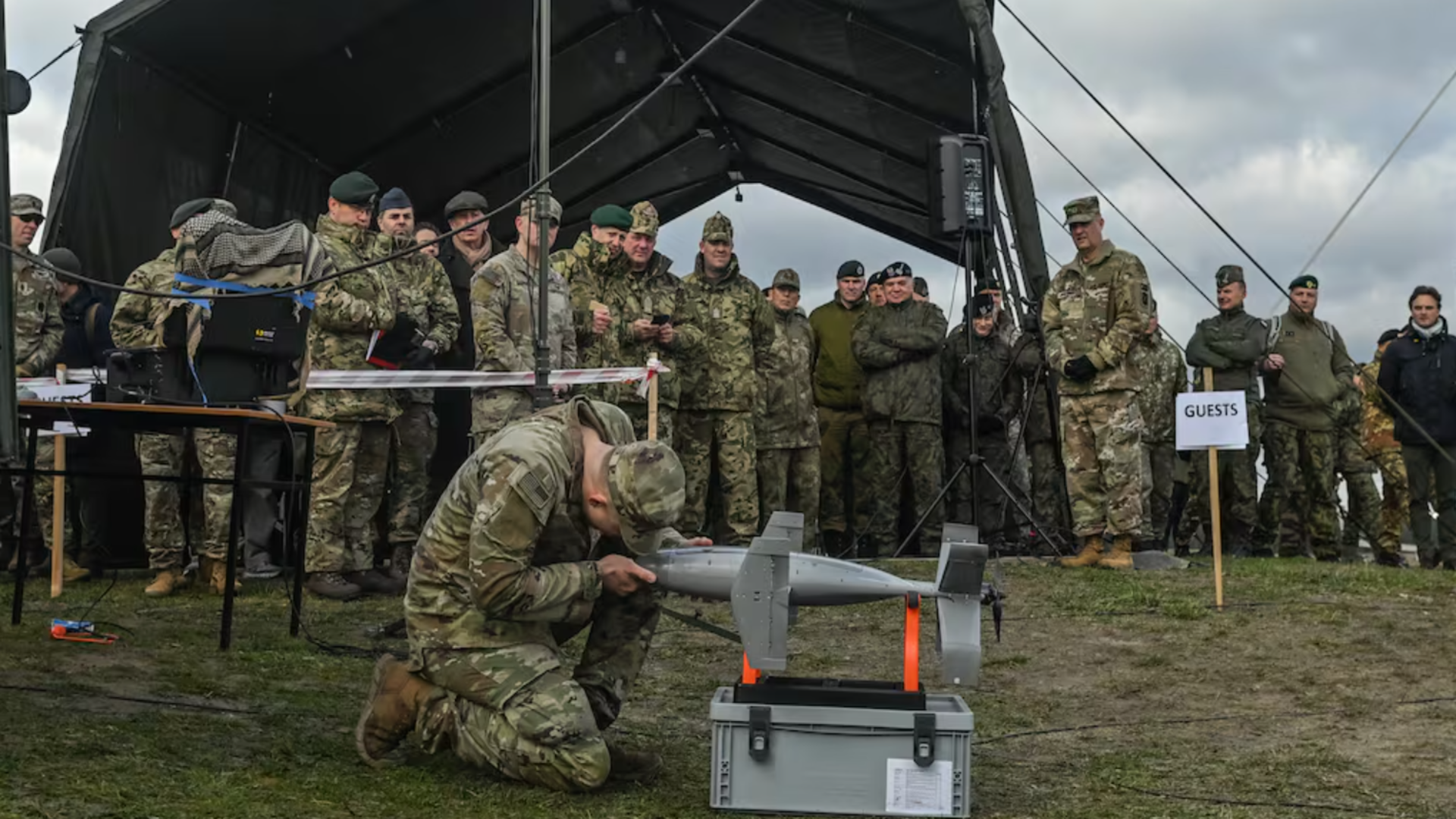
- Eric Schmidt's Perennial Autonomy wins Gauntlet II deep strike with 80.1 points, with a massive 9.2-point margin over the competition
- All four entrants tied directly to Ukrainian drone makers, including a Gauntlet I order winner, missed both top-five lists
- Ukraine's SkyFall still placed fourth indirectly in deep strike through British partner Skycutter, and Defender Media says another hidden Ukrainian firm also performed well
Perennial Autonomy, the drone company founded and funded by former Google CEO Eric Schmidt has topped the deep strike category of Gauntlet II, the second round of the Department of War's Drone Dominance Program.
The contests, which center around a straightforward goal of finding the most effective but cheap one-way attack drones in bulk, attract competition from across the globe as small and large players alike vie for the top five positions in each category that would allow them to secure production orders.
One of these tests is called "Deep Strike," and Perennial Autonomy not only delivered an impressive result, but it also kept some of its fiercest competition in check by a considerable margin.
The bigger surprise: who is missing?
While Perennial Autonomy's win and 9.2-point lead over the next-best competitor are impressive, they aren't a record by any measure: 4th-place holder Skycutter won Gauntlet I in March 2026 by about 12 points, showing that results can change quickly in an industry where innovation happens at a breakneck pace.
The more surprising part isn't Perennial Autonomy's impressive showing, but who failed to make it through.
Four entrants tied directly to Ukrainian drone makers reached the trials at Fort Carson, Colorado: Stellarion and Grim Tech under their own names, F-Drones through its US subsidiary UDD Tech Corp, and General Cherry through Wilcox Cherry Defense, a joint venture with US firm Wilcox Industries, according to a field breakdown by Challenging Defence Markets. Stellarion and UDD flew deep strike, while Grim Tech and Wilcox Cherry flew close quarters.
None of these are small-time players in Ukraine's burgeoning homegrown defense industry, however; Grim Tech, for example, claims to be delivering as many as 350,000 drones to the war effort monthly.
It does, however, raise the obvious question many would ask: why aren't any Ukrainian firms in the top 5 of the Deep Strike tests?
The scores are a sharp reversal from earlier in the year. At Gauntlet I, held at Fort Benning, Georgia, UDD was among the 11 companies that secured orders, according to reports. By mid-August, UDD was one of only three Gauntlet I vendors to complete deliveries, alongside Neros and Griffon Aerospace, according to Inside Unmanned Systems. Delivering on time evidently did not translate into a place on the new boards, where the merits of one's newest tech evidently trump past reliability.
On closer inspection, Ukraine's presence is quieter but more persistent than one might initially assume. This is because, while Skycutter is headquartered in London, the drone that won Gauntlet I was the Shrike 10, developed by Ukraine's SkyFall.
DroneXL summed up the SkyFall connection this way: "Ukrainian engineering did place, under a British flag." Defender Media's sources also say at least one more Ukrainian company performed well through a Western partner, but the firm has declined to comment, and the claim has not been independently verified.
Ukraine also had a hand in the current winner, albeit indirectly; Perennial began in 2023 as White Stork following Schmidt's meetings with Ukrainian officials, according to Inside Unmanned Systems, and has since traded as Project Eagle and Swift Beat. Neros won a 2025 contract to supply 6,000 Archer FPV drones to Ukraine and later opened a Kyiv office that year. The jamming deployed for the contests was also partly Ukrainian.
This does beg the question: why are companies from what is arguably one of the largest users and producers of attack drones falling short of the competition despite having the most battlefield experience in play?
The answer might be a little more unglamorous than one would like: Stellarion, the only one of the four to comment publicly, blamed logistics rather than its drones. Export permits and shipping dragged on so long that, as its representatives told , "This complicated the integration of products with American components, including warheads."
This adds to friction already built into the program: The Pentagon cannot buy directly from Ukrainian suppliers; contractors must be US legal entities registered with the Defense Counterintelligence and Security Agency, and significant foreign ownership brings extra conditions such as US-citizen leadership. Motors and batteries from certain countries were barred from August, and finalists had about five weeks to deliver 120 drones fitted with live payloads, underscoring that companies linked to the US industrial base would have a de facto edge.
Companies whose supply chains were built around Ukraine's front line therefore had the most to rebuild in the least time. That is a plausible explanation, not a confirmed one, and it may have cost them time, resources, and, down the line, a top-5 score in the Department of War's Gauntlet II.
As a result, one could argue that for Ukraine's drone makers, the next round (Gauntlet III) may be decided as much by permits, paperwork, and parts lists as by what actually happens during the tests themselves.

Rahim Amir is a UAE-based tech writer who enjoys building PCs as much as he enjoys writing about them. He has been professionally writing about PC hardware since 2023, focusing on buyer’s guides, hardware reviews, and sponsored content and features related to tech.
Having built hundreds of gaming PCs and being an avid gamer in his spare time, Rahim tends to have stronger opinions about hardware than most. This is particularly on display when he gets his way with powerful, but minimalistic RGB builds even as Small Form Factor (SFF) PCs come a close second.