I'm sitting in a small boat in Shark Bay, Australia, eavesdropping on a conversation between some of Earth's most intelligent beings. The motor is off, the turquoise sea is glassy, and Stephanie King and I are motionless, transfixed by the whistles, clicks and squeezy, whirring noises made by the dolphins swimming below us.
If anyone could tell me what these big-brained social mammals are saying, it would be her. Based at the University of Bristol, she co-leads Shark Bay Dolphin Research, one of the longest-running wild dolphin research projects in the world. She has spent thousands of hours watching and listening to this population.
Like most other animal behaviorists, King is increasingly integrating artificial intelligence into her research process. "If it's used responsibly, AI can transform what we can do with the data we collect," she says. But when I ask her if AI will someday allow us to "speak dolphin", she stiffens a little. "I think we're doing the animals a disservice by focusing on that question," she says.
The problem, King says, is not AI itself, but the narrative being built around it. She sees her field increasingly framed as a quest for an AI-assisted animal interpreter, with headlines declaring that we've almost "cracked the secret language" of various creatures or are about to "decode animals' speech". There are even cash prizes for breakthroughs, including the Coller Dolittle Challenge, which seeks an algorithm for communicating with non-human organisms.
"It's a sexy topic," King acknowledges, but in her view, fundamentally misguided. She believes the allure of tech dollars and media attention is priming the pump of research in some unhealthy ways – nudging scientists to make premature claims about AI-assisted findings, and encouraging them to describe their work in sensational terms. "They tend to be biasing themselves towards the most exciting discovery," says King, which "misleads us to what we know about these animals".
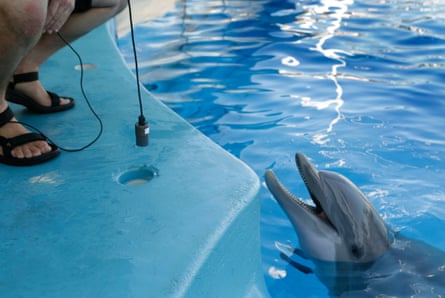
What we know, in many cases, is in fact very little. Take dolphins. "They've been studied for decades, but we're still scratching the surface with what many of the sounds mean," King says. Sound itself likely means something different to dolphins than it does to us. They can detect pitches far outside our range of hearing, they process acoustic information much faster than we do, and our sensory systems are wired differently in important ways.
For example, both humans and dolphins can echolate – or use sound to navigate – but dolphins process echolocation information in the part of the brain connected to touch, while for us, it's more connected to vision. In other words, instead of "seeing" with sound, dolphins might be hear-feeling, or feel-hearing, their way through their watery world. Whatever that experience is, it may be fundamentally inaccessible to us – and it's not something we can comprehend by plugging their whistles and squeaks into a large language model. "We need to appreciate that they have a complex communication system that we barely understand," says King. She believes our focus should be learning about that system – piecing together what dolphin behavior and communication means to other dolphins – rather than trying to hack into it, and start a conversation.
Elephant researcher Joyce Poole agrees. "I get quite exasperated by this goal of being able to talk to the animals," she says. "I think it's kind of gimmicky." One of the world's leading experts on African savanna elephants, Poole has spent decades observing the animals in the wild, building up a treasure trove of annotated field recordings of their vocalizations, movements and interactions. She's convinced that there are many layers and nuances of elephant communication that we don't yet understand, but, like King, she's skeptical about the concept of inserting ourselves into their dialogues. "Just the basic ability to understand what have to say and what they are thinking about – that's enough for me," she says. "I don't need to interfere in their lives more than necessary."
At the same time, Poole believes making the inner lives of elephants more legible to humans could transform how we treat them. "I hope that by showing that they're capable of a more sophisticated kind of communication that we gain them some respect from our fellow humans, and save a place for them in the world, together with their ecosystems and their other fellow travelers," she says.
Poole's hope is widely shared, and is likely one of the main reasons so many of us are prone to click on stories with headlines about how AI is going to help us talk to animals. As extinction numbers rise and biodiversity declines, we're desperate for some good news. Humans are also inherently fascinated by other animals; we've been telling stories about listening to and learning from them for as long as we've walked the Earth. Our technologies have in many ways cut us off from the rest of the living world – could this be a case when a new tool helps us to better tune into and care for our planetmates?
"I do see AI as a potentially promising avenue for knowing more, and understanding better, non-human animal lives," says César Rodríguez-Garavito, founding director of the More Than Human Life (Moth) program at NYU, a leading hub for research and discourse on the rights of nature. He thinks AI could help give animals a voice in the decisions that shape their lives.
"More and more researchers and practitioners are asking themselves, 'Well, how do we bring in the voices of, say, the whales in the regulation of a marine-protected area,'" he says. It may sound far-fetched to us now, but Rodríguez-Garavito says attempts to bring non-human voices into the realms of law and policy are already under way in countries around the world. "I think that this is no longer a science fiction question," he says. Of course, we don't need AI to tell us that whales are being negatively impacted by noise, ship strikes, climate disruption and pollution, but perhaps if we heard a direct translation of them expressing pain from underwater seismic testing, or mourning the loss of a calf killed by a ship, we would be more likely to act.
"But I cannot speak about potential benefits without speaking about risks," Rodríguez-Garavito says. "We have, as human beings, a very mixed track record, to put it gently, in using technologies." That record tells us that we can't simply deploy AI in the wild and see what happens; we need to think through the risks ahead of time. There's the possibility of intentional harm, like using AI-powered tools to trick or coerce animals, perhaps moving them into areas where they're easier to kill ("I mean, think of trophy hunters," says Poole). But if the past predicts the future, the greatest threats are not a few people using a new technology with malicious intent, but a whole lot of us using it without thinking about – or choosing to care about – the consequences.
"The nightmare scenario is one where we interrupt their communications and their lives at will, just for our entertainment," says Rodríguez-Garavito. It's not hard to imagine whale-watching companies using AI to lure animals toward boats, for example, or visitors to Yellowstone national park using apps to provoke wolves to howl, elk to bugle, or bison to bellow, exhausting and confusing the animals. Technologies are not beholden to the intentions of their makers. A tool created with the sincere goal of enhancing our respect for animals could end up having the opposite effect by turning them into playthings that we can pester and control.
-
Researchers Stephanie King and Laura Palmer document the movements and behaviors of a group of dolphins in Shark Bay. Buzzes and whistles from the dolphins are being picked up by underwater microphones and played through a speaker on the boat. Credit: Amy Martin, Threshold
In an attempt to help steer the field away from these dark scenarios, the Moth program recently published the Pepp framework (prepare, engage, prevent and protect), a set of ethical guidelines for the use of non-human animal communication technologies. But if and how it will actually get put into practice is uncertain. Rodríguez-Garavito says this is a trickle-down effect of the larger absence of legal and ethical boundaries around AI development. "At this point, there is no international agreement on AI," he says. "It is a free-for-all. I would be much less concerned if we had general principles on what can and cannot be done with AI. There's nothing like that, and this is why we're having to develop them from scratch based on what's been done in other fields of legal practice."
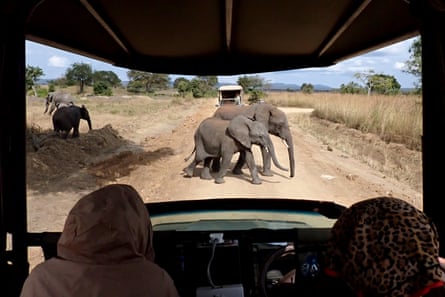
Mickey Pardo, who works with Joyce Poole as a senior scientist at ElephantVoices, also sees potential benefits and risks of AI-assisted animal communication tools, but he also wonders if the speculation is a bit overblown on both sides. "Playbacks can be stressful for animals even without AI – when you're just taking prerecorded sounds and playing them back – especially if you don't know the context of those sounds," he says. Maybe a more sophisticated AI version could add to that stress, but Pardo sees it more as turning up the dial on a problem we already have, versus opening an entirely new can of worms.
He also questions whether we're focusing too much on possible harms from AI when there are so many other ways we negatively impact animals' lives, including in research settings.
"The way that animals are treated in biomedical science is so incredibly horrific compared to anything that anybody's doing in the field of animal communication," he says. "Not that we shouldn't be thinking about the ethical implications [of AI] ahead of time. I just worry that perhaps we're sucking up too much oxygen worrying about a hypothetical ethical problem when there are many very real, present ethical problems that we're essentially ignoring."
This oxygen-sucking, mesmerizing effect of AI – the attention and money poured toward it, and the almost magical powers we're willing to ascribe to it – also concerns marine mammal researcher Luke Rendell, based at the University of St Andrews. "There's been this idea put about that AI is going to find something that we couldn't," he says. "It's something of a confidence trick, I think."
Rendell believes the AI hype has gotten way ahead of the science, and that the public is being led to believe that we know – or are about to know – much more than we actually do about animal communication. For example, Earth Species Project claims on their website that "with exponential advances in AI and Large Language Models, decoding animal communication is no longer a question of if – it's when" and states that they have already found support for their hypothesis that "AI can decode the shared structures of language across the Tree of Life".
-
King says AI can be a very helpful tool when used in the right ways, but spending time with the animals in their habitat is essential for understanding what their vocal communication means to them. Credit: Amy Martin, Threshold
This is the sort of framing that gives Rendell hives. Like Stephanie King, he believes pursuing a quest to reveal the "language" of animals is loaded with humancentric bias that could actually limit our understanding of their unique and wildly diverse ways of getting their messages across. He's also concerned about long-term damage to his field when the Dr Dolittle machine fails to materialize.
The study of animal communication has attracted a fair number of charlatans over the years, leading to boom-and-bust cycles of funding and credibility. Rendell says he entered the field of cetacean communication "just as it was recovering from a 15-year hangover" from the work of John Lilly, whose efforts to teach dolphins English using controversial methods – like giving them LSD – brought Lilly a lot of fame, but ultimately led to nothing but a tragic end for one of the dolphins at the center of his experiments. For more than a decade after that, the study of dolphin communication was "the punchline of a joke in scientific circles". says Rendell, but "we've had this flowering in the last 15 to 20 years of understanding and knowledge about cetacean society and communication", which he says has "taken the whole field on to a new level of credibility. And my main fear is that it is being undermined by these irresponsible claims."
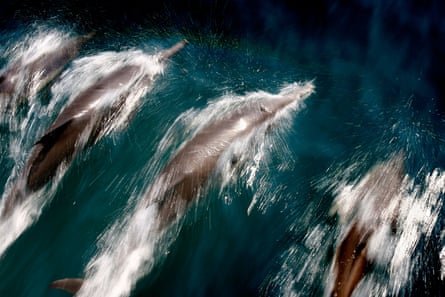
King says it all comes back to testing any AI findings with the experts: the animals themselves. "I think you have to use these AI and machine learning approaches alongside careful examination of the animals: when they produce calls, and in what context, and how they behave," she says. This is patient, painstaking work that requires careful studies in the field, often conducted over years – the opposite of Silicon Valley's "move fast and break things" ethos.
-
Dolphins detect sound waves through their lower jaws and produce sounds through the top of their heads. King describes how that works as buzzes made by a nearby dolphin are picked up by underwater microphones. Credit: Amy Martin, Threshold
The days I spent on the water with King involved a lot of quiet waiting, scanning the horizon for the glint of dolphins rising to the surface. When we spotted an animal, King would immediately beginning calling out names – Juicy, Jungle, Piccolo – while the scientists-in-training on the boat with us snapped photographs and took notes. King can identify hundreds of individual dolphins after the briefest glimpse of their dorsal fins, a skill she attributes to the countless hours she has spent in Shark Bay, observing the animals on site. "I come every year, and it's a really important part of my life," she says.
She also believes it's a really important part of doing good science. When they return from the field, her students will spend time looking through the photographs of the fins, matching them to pictures from previous years in their dolphin "look book". King says lately some students have been asking her to let AI do that work. It would, of course, be much faster. But she insists they do it manually. "If you really want to understand behavior, then the details matter," she says. "And the details take time. You can't rush it."
Meanwhile, a larger question looms for all of us: as exciting as it might be to imagine walking around with an animal translator in our pockets, do we have to wait for new technology to pay more attention to our planetmates? Because whether or not AI ever allows us to talk with animals, there's nothing stopping us from listening to them, and caring about their lives.