The pair were members of the informal Bloomsbury group, a loose constellation of gilded artists, writers and intellectuals centred around Gordon Square in central London. The group is coarsely remembered as much for its triangular romantic liaisons as its cultural contributions.
A new survey at Tate Britain attempts to bring the focus back to the duo’s work. The first room of Vanessa Bell and Duncan Grant: Inside Bloomsbury is a cameo of what follows. A pair of portraits by Grant introduce the couple in their early association.

A dramatic self-portrait of the artist wearing a teal headscarf (1910), his right arm posed to frame his face, is matched by a portrait of Bell (1911-1912), vibrantly costumed in a yellow shawl.
Several of the paintings in this room show the pair working at the leading edge of artistic style. Vanessa Bell’s Self-Portrait of 1915, the hero image for the exhibition, feels particularly connected with Parisian art of the period, suggesting the influence of Henri Matisse.
Closing the narrative in this first room, two touching self-portraits of later life show the artists grown together in style and life. The posture and attire in these two works are mirrored, and the radical edge of their youthful expression is rounded, mellowed. Bell’s self-portrait was made two years after Grant’s, in about 1958. In this there is a sense of resignation or departure. She died three years later, predeceasing Grant by 17 years.
Grant was introduced to Bell (then Vanessa Stephen) in 1905, by his cousin, at a weekly painting salon.
Their relationship deepened in 1909 when Bell wrote to Grant, suggesting that they drop formalities and address each other by their first names. Even though Grant was gay, and Bell was by this point married, the pair entered a close personal and creative relationship that endured for five decades and produced a child – the writer and painter Angelica Garnett. During this period, they both had numerous lovers.
As the exhibition’s curator Thomas Kennedy told me: “I think people bring it down to sex, but actually it’s about freedom. It’s freedom from the Victorian traditional norms that they had that they felt had been imposed upon them. So, actually, they were looking at new ways of living, and freedom to love who you wanted.”
In Britain today these freedoms are protected by law, however circumscribed they may be by the contingencies of normal life. But throughout this show, whether considering Bell and Grant’s advanced artistic style or evidence of their unusual lives, it is the very earliness of their acts that makes them radical, not necessarily the acts themselves.
The first room establishes the show’s theme. The rest of the exhibition walks the viewer through the artists’ work in a broad chronology. At art school, we see Duncan precisely but superficially copying from the French master Jean Siméon Chardin, missing the metaphysical heart of Chardin’s greatness. By contrast, there are two lovely still lifes by Bell, the slightly maladroit Iceland Poppies (1908-9), and Apples: 46 Gordon Square (c. 1908-1909). These two paintings are squarely Edwardian, but they capture more than the mere appearance of their subjects.
In the words of Bell’s sister, the novelist Virginia Woolf, “human character changed”, when the painter and critic Roger Fry came into the ambit of the Bloomsbury group. Through Fry’s show Manet and the Post-Impressionists, which was staged in London at the Grafton Galleries in 1910, Bell and Grant absorbed the influence and experimental velocity of the European avant-garde.
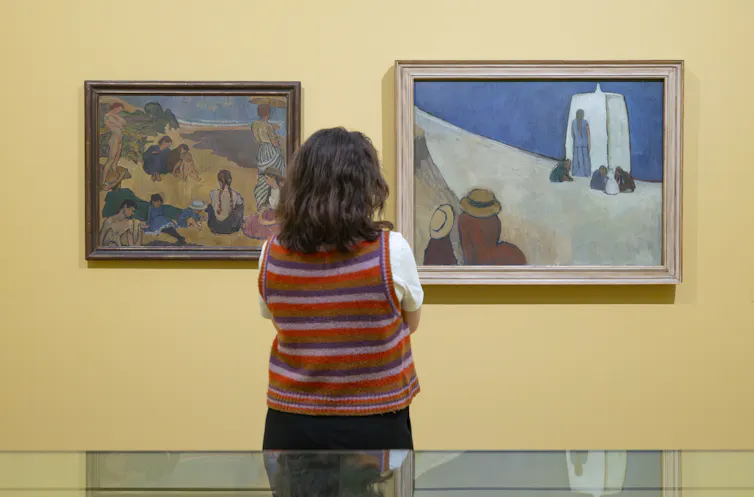
What followed was a frenetic period of innovation. Two paintings by Vanessa Bell of Studland Beach show her style evolve from something received from Paul Gauguin into to a radical pared down abstraction, a study in form and colour. There are several works in this room that are among the earliest purely abstract British painting. Stylistically, Bell and Grant came early to modernism. But much of the experimental work in this show needs the context of its early date to feed its impact.
The pair were pivotal in the Omega workshops, a commercial endeavour started by Fry, which aimed at closing the false distinction between the fine and decorative arts. This ran out of steam within six years, in Fry’s words due to the “utter indifference … of the public”.
It produced a wealth of charming objects, several of which are presented in this show, including a pair of impishly joyous fans made of ivory and silk, painted by Grant. Despite the closure of the Omega workshops, the pair’s flair for space and colour found expression in other designs for the stage, and commissions for interiors.
One stand-out work is Famous Women Dinner Service (1932-34), commissioned from the pair by the patrician art historian Kenneth Clark. This joint work features 50 portraits of female luminaries including Jezebel, Cleopatra, Elizabeth Tudor, Miss 1933 and – oddly – both Bell and Grant.
Created 40 years before Judy Chicago’s more celebrated installation The Dinner Party, which features a table set in celebration of 39 famous women, for once Bell and Grant’s slightly bonkers feminist dinner service seems decades ahead of its time, rather than a beat behind.

Retreat and domesticity
There is one small room, painted dark purple, that is undeniably all Grant’s. It’s a display of his “very private” erotic drawings.
These unpolished sketches depict gay sex, much of it acrobatic. Many are created on the reverse of receipts or other scraps. Forty of them were exhibited at Charleston, the artists’ Sussex home and now a museum, as recently as three years ago. Other artistically meritorious works in the main body of the show are testament to Grant’s sexuality. In an exhibition that aims for an unsensationalised reappraisal of Grant and Bell’s shared work, a roomful of private drawings unintended for display is an unnecessary tangent.
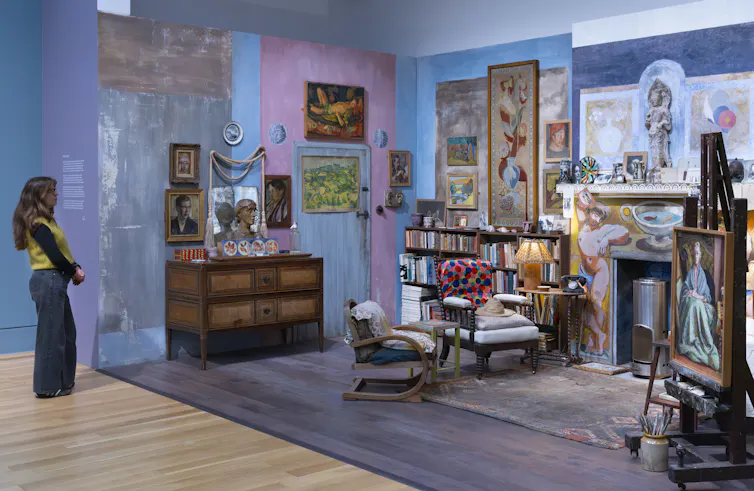
The concluding room features a recreation of the pair’s shared studio at Charleston, a painstaking endeavour that was three years in the preparation. This feels like another stage set, and by this point in the show their presence as characters is well established.
Ultimately, the exhibition tells the story of two leading lights of the Edwardian intelligentsia, in contact with the key ideas of the European avant-garde, shaping a British modernity before turning to a cosseted introversion. Much of the early work is radical, and some of the later work is beautiful. Not all of it feels vital.
Vanessa Bell and Duncan Grant: Inside Bloomsbury runs from November 12 2026 to April 11 2027 at Tate Britain