Every car will one day need an AI driving system, just as it needs seatbelts and emergency braking, Wayve chief executive Alex Kendall said. He spoke with Stellantis chief executive Antonio Filosa at Wave by Vento in Turin on Friday. Morgan Stanley’s Adam Jonas moderated.
“I think over time we’re going to see this kind of technology be required in vehicles like a seatbelt, like an emergency braking system,” Kendall said.
The technology is affordable enough for mass-market cars, and what happens on roads today is unacceptable, he said.
“So it’s really morally wrong to not have some system, some intelligence in the vehicle to save those lives,” Kendall said.
What the two companies are building
Stellantis and Wayve announced their partnership in May. Stellantis is putting the Wayve AI Driver into its STLA AutoDrive platform for hands-free, supervised driving. The first launch is targeted for 2028 in North America, Stellantis said. At Wave, the companies gave demonstration rides in a Fiat 500e and a Maserati Grecale.
The idea to put the system in the Fiat 500 came from a handshake about five months ago, Kendall said. Wayve tunes the AI to drive “Italian style”. He said he drove the Maserati on a track in Turin the night before, in pouring rain.
Wayve wants systems that run on less than $1,000 of hardware so they can reach mass scale, he said. Wayve also has a deal to put its AI into Mercedes-Benz production cars. It runs a supervised robotaxi service in London with Uber.
Each Stellantis brand will drive differently, Filosa said. AI will make each vehicle a self-learning machine. A Jeep will learn differently from a Peugeot or a Maserati. Customers will feel the difference between a Maserati and a Jeep, Kendall said, though both are built for safety first.
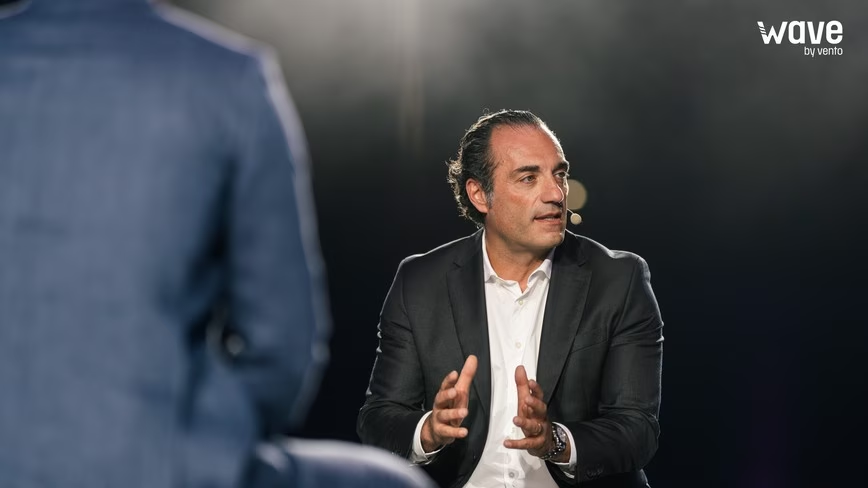
The partnership works because the two sides complement each other, Filosa said. Wayve brings the AI. Stellantis brings brand, vehicle and safety knowledge, and the scale that brings costs down. Stellantis develops a product in 24 months today, and AI can shorten that, he said.
From supervised to driverless
Kendall sees supervised driving as a stepping stone to eyes-off and driverless cars, not a separate business. Starting supervised introduces customers to the technology and builds the data needed to improve it, he said. It also gives a head start on supply chains and hardware, which take years in the car industry.
To go unsupervised, a system must be safer than a safety-conscious human driver, he said. That is a higher bar than an average driver. Wayve has training data from over 100 countries and has tested in 600 to 700 cities. It proves safety in simulation first, with its generative world model, Gaia, before it deploys.
Performance is growing by more than an order of magnitude a year, he said. The scaling curves look like those of language models. Kendall wants Wayve to be the intelligence layer for vehicles, and later for robotics too. Last month, he said Wayve’s AI would reach Mercedes cars within two years.