Serbia’s student-led political movement has secured a historic election victory. Preliminary results suggest the so-called Student List has won 141 of the 250 seats in parliament, with the ruling Serbian Progressive Party taking 104. The result brings the 12-year rule of Alexander Vučić to an end.
The Student List’s story is remarkable. It has no standalone leader and fielded candidates without political experience from across Serbian society. Stemming from student-led protests against the entrenched corruption and creeping authoritarianism of the ruling regime, it has now achieved an improbable dream.
In late 2025, one of us (Gavin Brent Sullivan) conducted focus groups with members of the student protest movement as part of the Pledge EU Horizon project. The project explores the emotional dynamics of political grievances and their democratic implications.
The protesters’ grievances were centred on the 2024 collapse of a roof at the newly renovated Novi Sad train station in northern Serbia, which killed 16 people. Allegations of state involvement through corruption in the procurement process and lowered building standards have been denied by the government. But they nonetheless sparked large nationwide protests.

Focus group participants expressed anger and underlying fear about harassment during the protests by what they said were government-funded gangs. They also spoke of their concern at the threats and violence directed towards them, not only as they protested but also when walking in areas near government buildings in main cities. Several students reported feeling threatened even in their own homes.
At the same time, the students voiced dissatisfaction with teachers who were not supportive of their movement, and other students who opposed them. This dissatisfaction extended to older family members and relatives who repeated government-controlled media fabrications about the protests. These included claims that the students were being paid by foreign anti-Serbian groups.
Despite the fear of arrest or worse, and despondency that change could really occur, the students who took part in the focus groups were resilient. They were focused on their long-term goal of regime change, with many students talking with pride about creating a leaderless movement that was organising candidates to challenge Vučić in an election.
Several participants reported feeling spontaneous, intense experiences of national pride when taking part in the protests. Some spoke of taking back national symbols such as the Serbian flag to counter propaganda that they were not patriotic and wanted to destroy the country.
Feelings of solidarity were also experienced when minority Bosniak Muslim students from Novi Pazar University in south-western Serbia joined the protests. As one participant said:
They’re a minority which was at odds with Serbia, with Serbian nationals actually. So now we had that part of reunification with them and they’re a Muslim minority. They are really active in these protests and student protests and it’s been wonderful.
Another member of the focus group noted that they expected elections to be “brutal”. But they were optimistic about the prospect of unseating the Vučić government. They said: “I see the glimpse of hope that this is our future and that actually we can say to our kids, our grandkids, we changed the system, we were the change.”
At the same time, most of the students did not dare to dream that they would succeed in ousting a government that had held a 12-year grip on power. It is stunning now after Vučić’s concession speech in which he admitted “it is clear that we have lost these elections” to know that they were successful just one year later.
What’s next?
The remarkable victory of the Student List should give hope to any group opposing a corrupt, authoritarian regime that a core commitment to democracy is precisely what attracts voters to choose progressive change.
However, while there will be euphoria, pride and tears of joy in Serbia as the election result sinks in, there may also be groups who are fearful of change and that the new government may seek accountability for members of the ousted regime. Some theorists of political emotions talk about the possibility for revenge to be enacted by winners, especially when a fight for power has been bitter.
For those on the losing side, meanwhile, electoral defeat can bring grief, anxiety and anger. But acknowledging these emotions and coming to terms with loss can bring openness to change. In his concession speech, Vučić said: “I do not want unrest, I do not want killings, I do not want anything like that on the streets.”
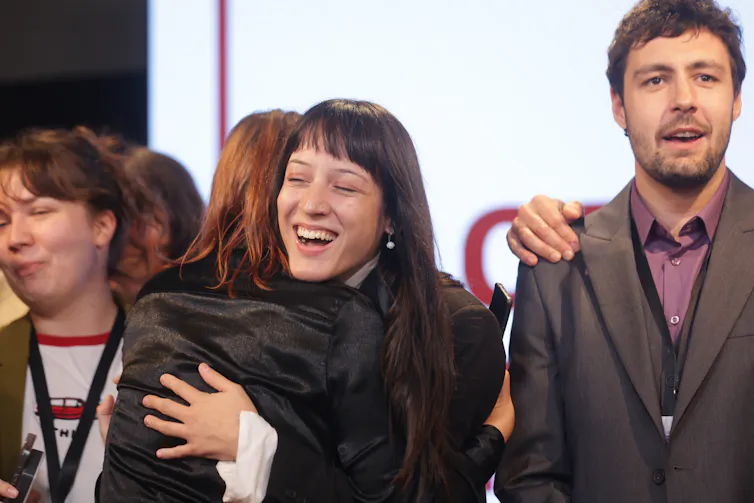
The Student List’s commitment to democracy, pluralism and justice should also override any desire for redress. The movement has actively avoided developing a victim identity, taking responsibility for enacting change themselves.
As one focus group participant said:
Of course, they [the government] are the problem. I’m not trying to deny that. But I would blame us more … because, I mean, we chose them, we keep choosing them. Okay, they do steal when it comes to the elections, they do many things, they hide, they try to control the media and everything. But at the same time, we don’t have the opposition and we have that state of mind that is allowing them to do everything they’re doing.
There are various other challenges facing the Student List. These include adapting the movement’s leaderless organisational assemblage into a government capable of delivering the reforms required for EU membership.
But regardless of what happens next, it was certainly a privilege to talk to the students at a time when change did not seem possible and to provide encouragement and support when there was little outside recognition of their struggles and sacrifices.