The new Premier League season is now well underway and for many football fans, that means crowded pubs, beers with friends and betting on favourite teams. These rituals can often feel like a natural part of the game.
But football’s close association with alcohol and gambling did not emerge by accident. Over decades, sponsorship deals, advertising campaigns and commercial partnerships have made drinking and betting feel inseparable from the sport itself.
The scale of that exposure is striking.
Over the course of a weekend during the Premier League season, a viewer may see as many as 27,000 gambling messages and up to 54 pro-gambling messages per minute of match time.

Health Gap / Sundhedskløften is a collaborative series from The Conversation UK and Denmark’s Videnskab.dk exploring what the two countries can learn from each other when it comes to health and wellbeing.
From cycling and alcohol to inequality, healthcare and everyday habits, the series looks beyond hospitals and medical treatment to explore how culture, politics and society shape the way people live – and how healthy they are.
Looking at both countries side by side offers an interesting comparison. Denmark and the UK are often seen as quite different in their policy and welfare decisions. Yet both have allowed alcohol and gambling industries to become highly visible parts of the football experience.
This matters because alcohol and gambling can cause serious harm. Alcohol is one of the biggest causes of preventable early death. The figures for 2023 show that in total, around 23,600 people died from alcohol-related deaths across the two countries.
Gambling, including sports betting, can also cause serious financial problems and affect people’s health, wellbeing, and relationships. Research shows that about 2% of Danes and 3% of Britons experience problem gambling.
Lax regulation
Despite this, both countries have taken relatively lax approaches to regulation. In a cross-country comparison, we found Denmark to be among the bottom five out of 18 European countries when it comes to statutory alcohol control. Alcoholic drinks are cheap and widely available, with only a few restrictions on alcohol marketing.
The UK performs somewhat better, with higher prices and tighter licensing rules for alcohol sales, but alcohol advertising and promotion remain deeply embedded in everyday life and sport.
A similar picture emerges around gambling. Denmark has adopted a more liberal approach to gambling regulation than many other Nordic countries, particularly since the market was opened up to greater private competition in 2012.
Advertising rules mainly focus on the content of adverts. For example, preventing companies from presenting gambling as a solution to financial problems or directly targeting children, rather than limiting the overall volume of marketing exposure.

In the UK, gambling regulation has also been criticised for placing too much emphasis on individual responsibility rather than the wider commercial environment surrounding betting, with suggestions that UK gambling policy protects the gambling industry more than it prevents harm to gamblers.
Indeed, the UK’s 2005 Gambling Act framed gambling-related harm largely as a matter of individual responsibility, rather than focusing on the industries and advertising that promote and profit from problem gambling.
This language of “responsibility” runs through both industries. Since the mid-2000s, gambling campaigns in the UK have encouraged people to “gamble aware” and “when the fun stops, stop”. Drinkers are given similar advice to “drink responsibly” in both countries. Yet, these industries rely heavily on high levels of consumption for their profits.
In the UK, for example, those consuming above the recommended guidelines account for almost 70% of alcohol sales. For gambling, it’s even worse – 86% of online betting profits come from just 5% of customers.
But there are signs that things are starting to change. In the mid-1990s, six Premier League clubs were sponsored by alcohol brands. Today, there are none, and alcohol sponsorship has disappeared from the league entirely. Gambling shirt sponsorship is also set to be phased out in the Premier League from the 2026-2027 season.
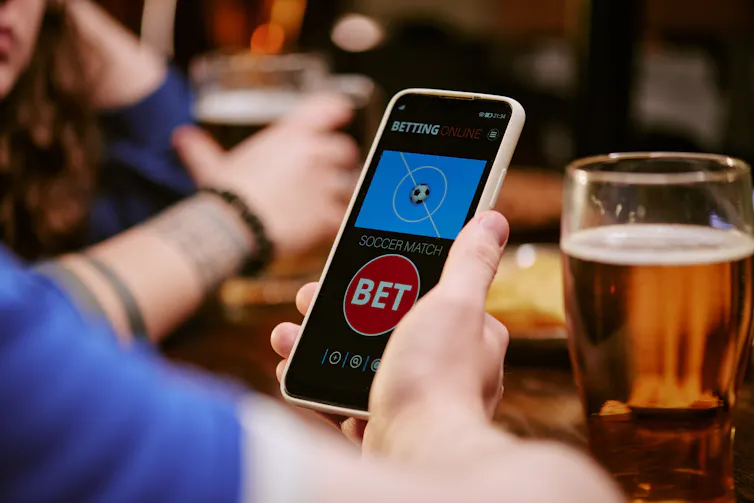
Denmark is likewise introducing new rules to tighten gambling advertising regulation. This includes a “whistle to whistle” advertising ban, preventing adverts ten minutes before, during and ten minutes after games.
Taken together, these changes reflect a growing recognition that messages about “personal responsibility” sit uneasily alongside constant advertising and industries that depend heavily on excessive use for most of their profits.
More broadly, it also raises an important public health question: how much of what we think of as personal choice is shaped by the commercial environments around us?
So when you’re next watching a football match, you might like to count how many gambling adverts you see. And when you see a promotional offer linking football and beer in the supermarket, pause to think why drinking and betting have come to feel so closely tied to the game in the first place.

This series was commissioned as part of a partnership between Videnskab.dk and The Conversation, where articles are published in English and Danish.