On an Ethiopian plateau, a bull called Achille formed an unusual relationship with a male donkey named Patroclo. They were observed spending time together, licking and rubbing against one another, and repeatedly having penetrative sex.
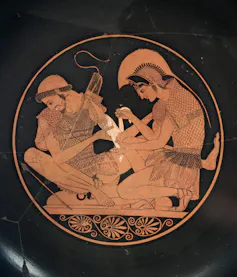
The animals’ names nod to Achilles and Patroclus, the Greek mythological figures whose bond has been debated for thousands of years: devoted friends – or lovers? A new study in the journal Current Biology asks something similar about Achille and Patroclo: why would two males of different species repeatedly choose each other as sexual partners when females of their own species are available?
Perhaps the more interesting question is why we find their relationship so surprising.
A chance find
The researchers first noticed Achille and Patroclo while studying gelada monkeys in Ethiopia. Intrigued, they began observing the pair more closely.
They recorded 51 mounting attempts, 34 of which involved penetration. Patroclo took an active role, presenting his hindquarters to Achille and initiating contact. Unlike another male donkey that Achille approached, Patroclo did not show obvious signs of trying to avoid him.
The donkey and bull often showed affection towards each other immediately after mounting. This suggests that sex may help strengthen their bond.
The researchers observed the pair in detail for just four days, so they cannot say how long the relationship lasted. Even so, the findings are unusual because the two animals are both male and belong to different species.
Same-sex sexual behaviour has been reported in more than 1,500 animal species. A 2023 study documented it in 261 mammalian species and found that it was particularly associated with social species, suggesting a possible role in maintaining relationships and managing conflict.
As a primatologist, I am not surprised by these findings. Bonobos, for example, are famous for their frequent sexual interactions, which occur in many combinations of partners. Female–female genital rubbing, for instance, is associated with affiliation and social bonding. Sexual interactions can also help manage social tensions.
Same-sex sexual behaviour takes many forms. Male bottlenose dolphins mount one another and rub genitals in groups that cooperate to gain access to females, while female Japanese macaques form temporary sexual partnerships involving repeated mounting. Same-sex sexual behaviour may play a part in establishing status, settling disputes, forming friendships or sexual enjoyment.
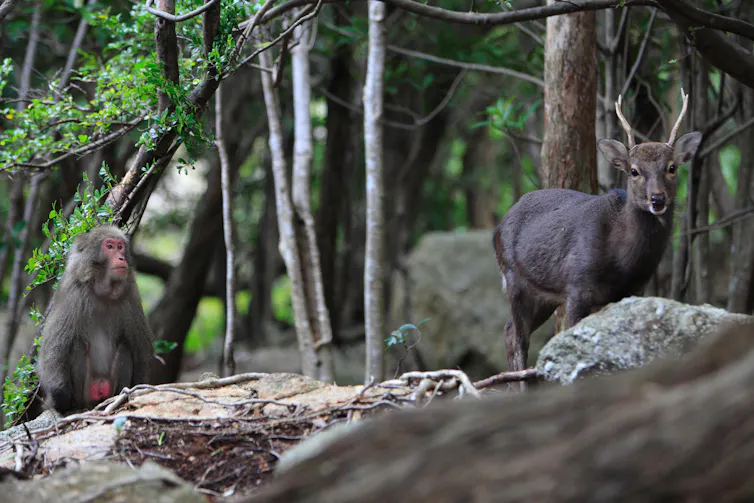
Sexual behaviour between different species is rarer, but it is not unheard of. Both male and female Japanese macaques, for example, mount sika deer. Unlike the apparently reciprocal relationship between Achille and Patroclo, these encounters do not necessarily involve mutual sexual interest.
What makes Achille and Patroclo particularly interesting is that they combine sexual activity with apparent affection and a preference for each other.
Evolutionary biologists have traditionally approached same-sex sexual behaviour as a puzzle. If natural selection favours traits that contribute to reproductive success, why should animals spend time and energy engaging in sexual behaviour that cannot directly produce offspring?
Suggested explanations include mistaken identity, a lack of opposite-sex partners, or indiscriminate sexual behaviour with whichever individuals happen to be nearby. But all these explanations begin with an assumption that sexual behaviour between males and females is the default, and same-sex behaviour represents a departure from it.
In a provocative 2019 paper, a team of researchers challenged this assumption. They proposed that the ancestors of sexually reproducing animals may have been relatively indiscriminate about the sex of their sexual partners. Rather than assuming that different-sex sexual behaviour came first, they suggested that the ability to distinguish between potential partners, and preferentially direct sexual behaviour towards the opposite sex, may have evolved later.
Taking a queer perspective
This is a brilliant example of how queer perspectives can enrich evolutionary biology.
Queer approaches encourage scientists to examine how human assumptions about sex, gender and sexuality influence the questions we ask, the categories we use and the explanations we consider plausible. They do not require us to assign human sexual identities to animals.
Observing same-sex sexual behaviour does not tell us that an animal is gay or establish a fixed sexual orientation. Instead, queer approaches encourage us to take the diversity of animal sexual behaviour seriously, without assuming what is normal or what needs explaining.
The authors of the new study suggest that Achille and Patroclo’s sexual interactions may help maintain their social relationship. They also discuss the possible reproductive costs of spending time and energy on sexual activity that cannot result in offspring.
But this framing raises another question. Why should we assume that sexual behaviour must contribute directly to reproduction to have evolutionary significance?
Social relationships can influence survival, access to resources and future reproductive opportunities. Sexual behaviour that strengthens those relationships may therefore have adaptive benefits, even when it cannot directly produce offspring. Equally, sexual behaviour may arise from evolved mechanisms without every individual encounter necessarily providing an animal’s reproductive success.
Achille and Patroclo cannot tell us why they choose one another. This short study can’t tell us what evolutionary purpose, if any, their relationship serves. But it does remind us that animal behaviour can be more diverse than our theories suggest.
Perhaps the most important lesson is not that a bull and a donkey have formed an unusual sexual relationship. It is that understanding such relationships requires us to question our assumptions about what sex is, what it does, and what counts as natural.