EU leaders gathered in northern Finland recently for a summit focused on reaffirming the importance of the Arctic region to European security. The meeting, which took place in the city of Rovaniemi, came a month before the EU is expected to release its updated Arctic policy.
This will be the first update since 2021, during which time the geopolitical climate has undergone considerable change. After Russia launched its full-scale invasion of Ukraine in 2022, for example, the work of the Arctic Council was put on hold.
The seven other Arctic states had previously used this forum to engage with Moscow directly, using it to exchange information and promote cooperation on issues such as environmental protection and development in the region.
Russia has stepped up its military, economic and strategic activities in the region over the intervening years.
On September 10, it was reported that a joint operation between the UK, US and Norway earlier in 2026 successfully disrupted Russian vessels simulating the deployment of a weapon designed to disable undersea cables near the remote Norwegian archipelago of Svalbard.
Russia has also deployed an underwater surveillance network in recent years made up of cables, sensors and sonar to detect Nato submarines in Arctic waters. The Northern Fleet, which is responsible for Russia’s nuclear defence, is based on the Kola Peninsula near the border with Norway.
At the same time, Russia’s state-controlled energy company Rosneft has pushed forward with its Vostok Oil project, a vast Arctic development through which Moscow aims to boost oil production. Russia recently began exporting oil from the project commercially.
Much of Russia’s oil is exported by its shadow fleet, a network of sanctioned tankers that operate from the Russian Arctic. The fleet has expanded rapidly since 2022, with some of its vessels suspected of engaging in spying and sabotage in European waters.
Read more: Inside the booming ‘shadow fleet’ industry keeping rogue states afloat
The Finnish prime minister, Petteri Orpo, told the dignitaries gathered in Rovaniemi that “Russia is the most significant threat” to the European Arctic. He added that there was a high demand for “concrete action from the EU”. But what form should this action take?
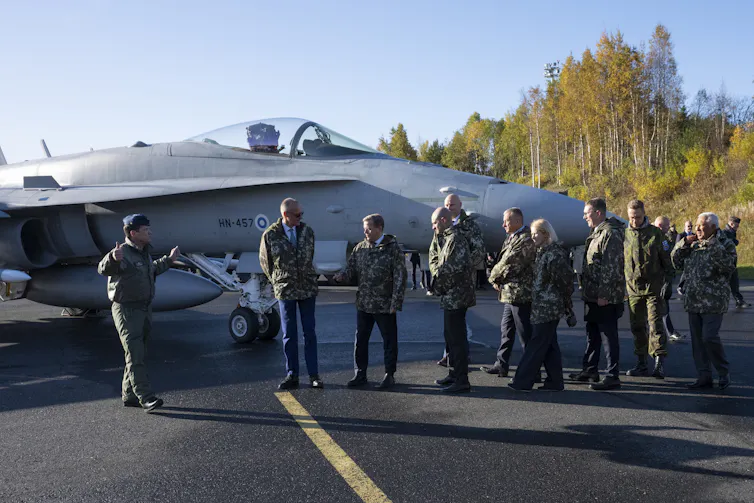
There are two main priority areas. First, Europe needs to boost its capacity to monitor and react to Russian activities in the Arctic. Intelligence gathering, surveillance and reconnaissance remain a key challenge in the high north, primarily due to the existence of satellite communication gaps at high latitudes.
Located north of Norway and Russia, the Barents Sea is also a hotspot for GPS jamming and what is known as “spoofing”, where vessels or aircraft broadcast fake navigation data to hide their true location. This makes the maritime and aerial environment in the region unsafe.
Nato is currently investing in two systems designed to improve satellite coverage across the Arctic region. These include the Alliance Persistence Surveillance from Space programme and Northlink, both of which draw on commercial and government space assets.
But, in general, there is still a pressing need for Europe to invest in more sensor networks and uncrewed systems to monitor Arctic waters.
The second priority is to bolster the physical presence of EU states in the Arctic. Third-party Nato states such as the UK already work closely with Iceland and Norway, two of the EU’s key Arctic partners. There are 1,500 Royal Marines stationed at Camp Viking in northern Norway alone.
At the meeting in Rovaniemi, Orpo suggested that the EU fund a European fleet of icebreakers, the vessels required to access and navigate much of the Arctic. Finland has a key role to play here. Around 80% of the world’s icebreakers are currently designed by Finnish firms and more than 60% are built in Finnish shipyards.
Trade, resources and energy
Protecting Europe against Russian threats is perhaps the core driver of the desire to strengthen the EU’s Arctic presence. But EU leadership also recognise that the Arctic is undergoing environmental change. This change will inevitably necessitate more activity in the region, beyond mere deterrence.
As sea-ice melts due to rising temperatures and shipping routes elsewhere become more precarious, including around the Red Sea, the temptation to use Arctic waters to move goods between markets in Europe and Asia will grow. Chinese and South Korean vessels have already undertaken summer season crossings using this route.
Moving forward, the EU’s resource and energy strategy will also depend heavily on the European Arctic. This is despite the bloc announcing on September 21 that it will maintain its ban on new oil and gas drilling in the Arctic.
The Nordic region holds massive reserves of iron, copper, cobalt, nickel and rare-earth elements. So, with the EU’s target of securing 10% of its strategic raw material needs from domestic sources by 2030, mining in European Arctic states such as Sweden and Finland will be essential for strategic independence.
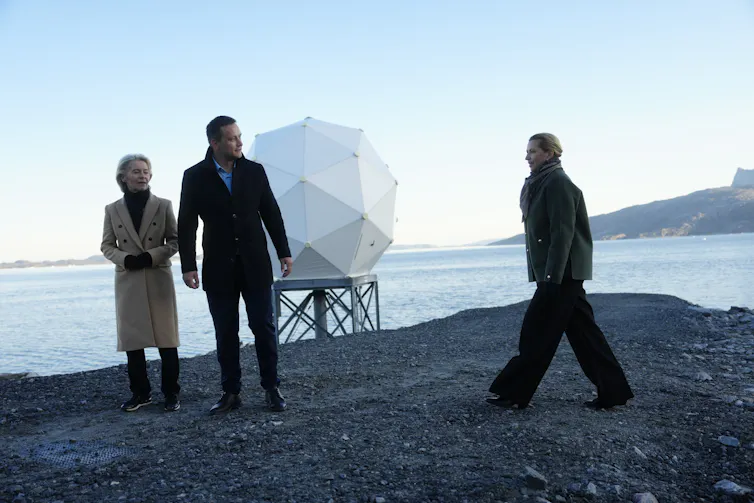
Courting Greenland, a resource-rich autonomous territory of Denmark that recently signed a deal with the US that allows Washington to build two military bases there, is another element to all of this.
The EU has allocated a €200 million (£171 million) investment package across 2026 and 2027 to support clean energy and the mining of critical raw materials in Greenland.
Visiting Greenland in September, the European Commission president, Ursula von der Leyen, said the funding would “create new opportunities”. The hope is that hundreds of millions of euros will follow for resource-related projects in the territory.
The Arctic has become a geopolitical frontier – and EU leaders are scrambling to ensure they are not left behind.