The problem
After more than 20 years of academic research, supervision and contributions to engineering technology in Latin America, I’ve been pursuing faculty positions at universities in North America and Europe. The advertised positions match my expertise closely, but my applications have been consistently unsuccessful.
The reason only became clear through a candid exchange with a colleague who had served on a selection committee for one such position. My scientific qualifications, he noted, were competitive. The factor that stopped the committee choosing me was that I hadn’t obtained grant funding from the national research system of the country I wanted to move to.
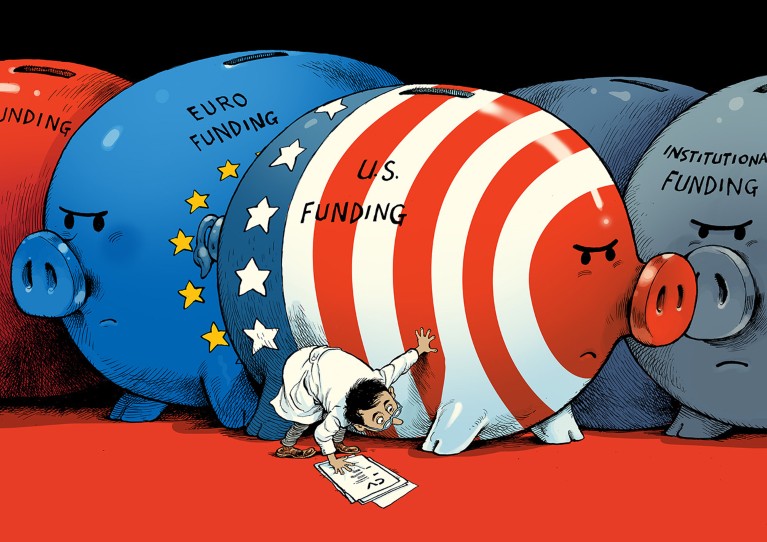
This is a problem with how funding is structured in most research-intensive countries. Grant mechanisms are often national and tied to taxpayer-supported programmes that do not enable researchers based abroad to be awarded principal-investigator status. International collaboration is actively encouraged in research, but international leadership of funded projects is another matter entirely. The practical consequence is that no amount of scientific output or achievement by an individual can compensate for this gap.
Is there anything that an applicant can do to combat this bias? — An excluded international scholar
The advice
César Marín, an ecologist at Santo Tomás University in Santiago, Chile, agrees with you. “Demonstrating experience and success on getting national funds seem to be the main hiring criteria in many countries — regardless of strong publication and supervision record,” he affirms.

An ‘agony aunt’ for working scientists
In general, experience of a local system “can be an implicit metric in academia”, notes Laura Ación, co-executive director of MetaDocencia, a capacity-building organization for researchers from Spanish-speaking communities. MetaDocencia’s research on the career paths of Latin American scientists1 suggests that, as Ación says, “a lack of competitiveness for European or US funding constitutes a structural disadvantage”.
This can take a toll on academic jobseekers. “I believe that, as a foreigner, I am behind the competition for many reasons,” explains Renan Lyra, a Brazilian psychology researcher who is currently searching for positions in the United Kingdom. He suspects that one of the reasons is that researchers doing UK degrees are trained to put together domestic grant applications, and are more likely to be involved in such applications with senior researchers. Experience in bringing in money is what hiring organizations really care about, Lyra thinks.
Even researchers moving between well-resourced systems notice the gap between them. Caroline Lynn Kamerlin started her independent career in Sweden before moving to the United States as a professor. She’s now a computational chemist at the Georgia Institute of Technology in Atlanta.
During the transition, she encountered what you describe: “When US hiring committees saw my CV, the biggest thing they saw was that I had no US funding, and the fact that I had clearly been able to get funding from several sources in Europe was not something they considered.”
One reason for hiring managers’ funding bias might be that they are familiar with certain grants, which come with a kind of brand recognition that is associated with high quality. But this can be problematic if the assumption is “that global-south grant processes are not as strict as those from the global north”, Marín comments. “On my own experience of reviewing grants for European and Latin American countries, this is not always the case.”
As you identify, this is a structural problem, so there are limits to what a single person can do. Still, there are ways for individuals to increase their chances of being hired, even in an unjust system.
Grant strategies
One way of boosting your grant track record is by forming international collaborations. But as you note, collaboration doesn’t necessarily build to leadership. And in the United States, restrictions on grants involving foreign researchers are making international collaborations of all types more challenging.

How a spreadsheet helped me to land my dream job
Marco Seeber, a science-policy researcher at the University of Agder in Kristiansand, Norway, says you shouldn’t underestimate the importance of trust and personal connections in the systems you’re trying to break into. The first stage could be attending and presenting at conferences, and using that as a jumping-off point for collaboration.
“I cannot emphasize strongly enough how vital it is to cultivate a diverse, robust network and community throughout a scientific career,” Ación adds. This should be reciprocal, not transactional. For instance, it can include service to scientific associations. That kind of network-building could eventually pave the way for entry into another country’s research system.
Even if you aren’t successful in getting a grant on which you’re a principal investigator (PI) in the desired country, that might not be a deal-breaker. “I think being a PI on international grants is always helpful, but it’s not absolutely necessary, just because there are so few international grants and those that exist are incredibly competitive,” Kamerlin says. If it’s still important to you to be a PI, it’s possible that the other collaborators in your consortium would be happy to have that administrative burden taken off their hands, and for you to take on the leadership role.
Some funding calls are geared towards foreign researchers of different levels, which could help you to develop a track record in the research system you’re interested in. Kamerlin highlights the European Research Council (ERC) funding schemes. “The ERC specifically wants to attract and retain the best talent in Europe, and actively encourages non-Europeans to apply to move to Europe,” she says. Admittedly, success rates are low. ERC starting grants, which are geared towards early-career researchers and can come with extra funding for researchers moving to the European Union, had a success rate of about 12% in 2025.
More broadly, in 2025, the European Commission kicked off the Choose Europe initiative to attract researchers to the EU. Although one impetus was to draw in researchers from the United States who are disillusioned with the cuts to science funding there, in principle, applicants can be of any nationality.
Enjoying our latest content?
Log in or create an account to continue
- Access the most recent journalism from Nature's award-winning team
- Explore the latest features & opinion covering groundbreaking research