The Revolutionary Origins of Language Chris Knight & Jerome Lewis Yale Univ. Press (2026)
The origins of writing and script remain unclear, but those of speech and language are simply unknown. This is because no physical evidence remains of the earliest language, which was probably spoken in Africa, the birthplace of Homo sapiens. By contrast, inscribed marks on clay tablets that constitute the earliest known form of writing — however mysterious — have survived from ancient Mesopotamia, dating to the fourth millennium .

Humanity spoke thousands of languages at the dawn of farming — now many of them are lost
That’s left a lot of room for scholars to speculate on how speech and language began, starting with thinkers from the ancient world, including Plato, who could not decide whether language had a natural or a purely human origin. By the nineteenth century, anthropologists had grown tired of so much talk with scant evidence to go on.
In 1866, the founding statutes of the Paris Linguistic Society forbade all discussion of the subject, note anthropologists Chris Knight and Jerome Lewis in The Revolutionary Origins of Language. “Anyone theorizing about the origins of language risked being dismissed as a crank.” Even so, “from time to time, this or that brave maverick would risk whatever reputation they had by attempting to reopen the debate”.
Science of linguistics
The best known, if controversial, attempts since then come from linguist Noam Chomsky, starting in the 1960s. The authors discuss his contributions at length, drawing on Knight’s book Decoding Chomsky (2016).

How the world’s largest language family spread — and why others go extinct
In 1987, Chomsky remarked in Language and Problems of Knowledge that: “There is a long history of study of the origin of language, asking how it came from the calls of apes and so forth.” But, in his view, this investigation is a “complete waste of time”.
That’s because language is based on “an entirely different principle than any animal communication system”, he wrote. Although human gestures might have evolved from animal communication systems, the same could not apply to human language, Chomsky thought.
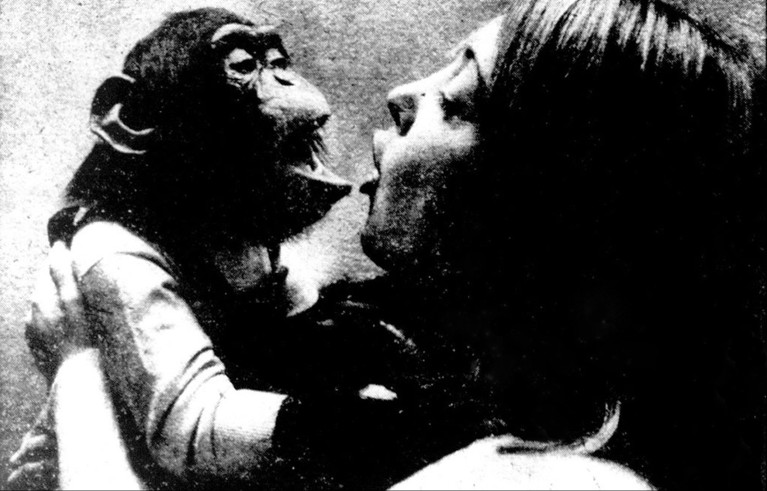
This view was supported by an academic study, launched in 1973, of a young chimpanzee (Pan troglodytes) with the punning name Nim Chimpsky. Nim learnt from his human supervisors how to make dozens of hand signs to procure food and other rewards, but not how to communicate in American Sign Language or to speak a language. “Give orange me give eat orange me eat orange give me eat orange give me you” was Nim’s longest recorded sign-language sequence, as cited by Knight and Lewis.
In Chomsky’s view, human language arose suddenly because of a single genetic mutation, not from Darwinian natural selection or through a gradual, adaptive cultural process. In other words, argue the authors, by declaring language to be “an especially intriguing and mysterious aspect of the natural world, to be investigated using the normal methods of natural science”, Chomsky elevated the study of linguistics to a scientific challenge in the field of anthropology.
However, they add, “there is no measuring device, magnifying glass, telescope or other instrument which can grasp the meaning of a word.” So how can conventional science investigate language?
Social origins
Rejecting Chomsky’s view, Knight and Lewis instead offer a complex mixture of evidence, both scientific and cultural, to support their own theory. This evidence is mostly drawn from prehistoric and present-day Africa, where Lewis spent three decades studying hunter-gatherers, notably the BaYaka people in Central Africa.
“To qualify as science, a hypothesis must suggest testable predictions,” the authors remark. Given that there can be no direct evidence for events in the distant past, scientists must therefore “construct tests from a wide range of telltale clues”. These include: “recurrent structures of magical myth, initiation rituals, hunters’ taboos, patterns of menstrual prohibition, lunar and solar influences, and critically, archaeological evidence for symbolism in the form of red ochre pigments and personal ornaments”. All of these clues are examined in their intriguing, if rambling, book.
AI is helping to decode animals’ speech. Will it also let us talk with them?
Although anthropologists have often suggested that speech and language arose from hunting or warfare, Knight and Lewis refute these two theories. While hunting in the forest, male hunter-gatherers “do their utmost to avoid having to speak aloud”, so as to lure animals towards them. Instead, they use sign language to alert each other to the nearby presence of animals such as gorillas, antelopes, leopards and elephants.
Enjoying our latest content?
Log in or create an account to continue
- Access the most recent journalism from Nature's award-winning team
- Explore the latest features & opinion covering groundbreaking research